The creation of my works: from seed to flower
This article describes how my paintings come into being. Every artist's creative process is different. If you are a collector, this insight will deepen your understanding of original art; if you feel the calling of a painter yourself, it may offer a few starting points for your own creative journey.
Phase 1: Cultural immersion
For many years I have immersed myself regularly in the work of the great Masters. Painting is my passion. The Masters — whether old or contemporary — are above all creators who have shaped the art world across centuries, and they remain examples to study and reflect upon.
Beyond the traditional sources — museums, galleries, art fairs — YouTube and the internet have made modern art far more accessible. These tools allow artists to absorb the talent of both old and contemporary Masters, and to visit virtually the galleries representing today's painting.
My tastes were first shaped by Spanish painting, particularly Sorolla and Mir, then by the German Expressionism of Emil Nolde, and finally by Serge Poliakoff in the realm of abstraction. Each of these Masters has influenced, to varying degrees, my way of painting and creating.
To explore some of my works: cluchier-art.com
Phase 2: Conceiving the work
My paintings do not come into being in a single day. They are the result of reflection and a gradual maturation over time. Whether abstract or figurative, my process is always the same: I keep a sketchbook that I fill month after month, guided by my mood and instinct.
The faces of figures are entirely invented and represent no one in particular. As a rule, I do not start from reality — I actively try to detach myself from it. I focus on composition and the balance of colours. The final result reflects what I carry in my mind at the moment of painting. I browse my sketchbook and, depending on my state of mind, choose the sketch that speaks to me most strongly at that particular time.
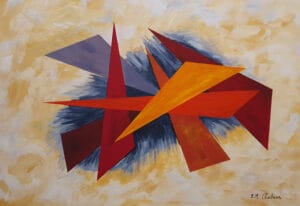
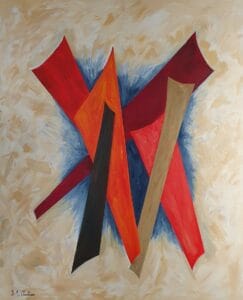
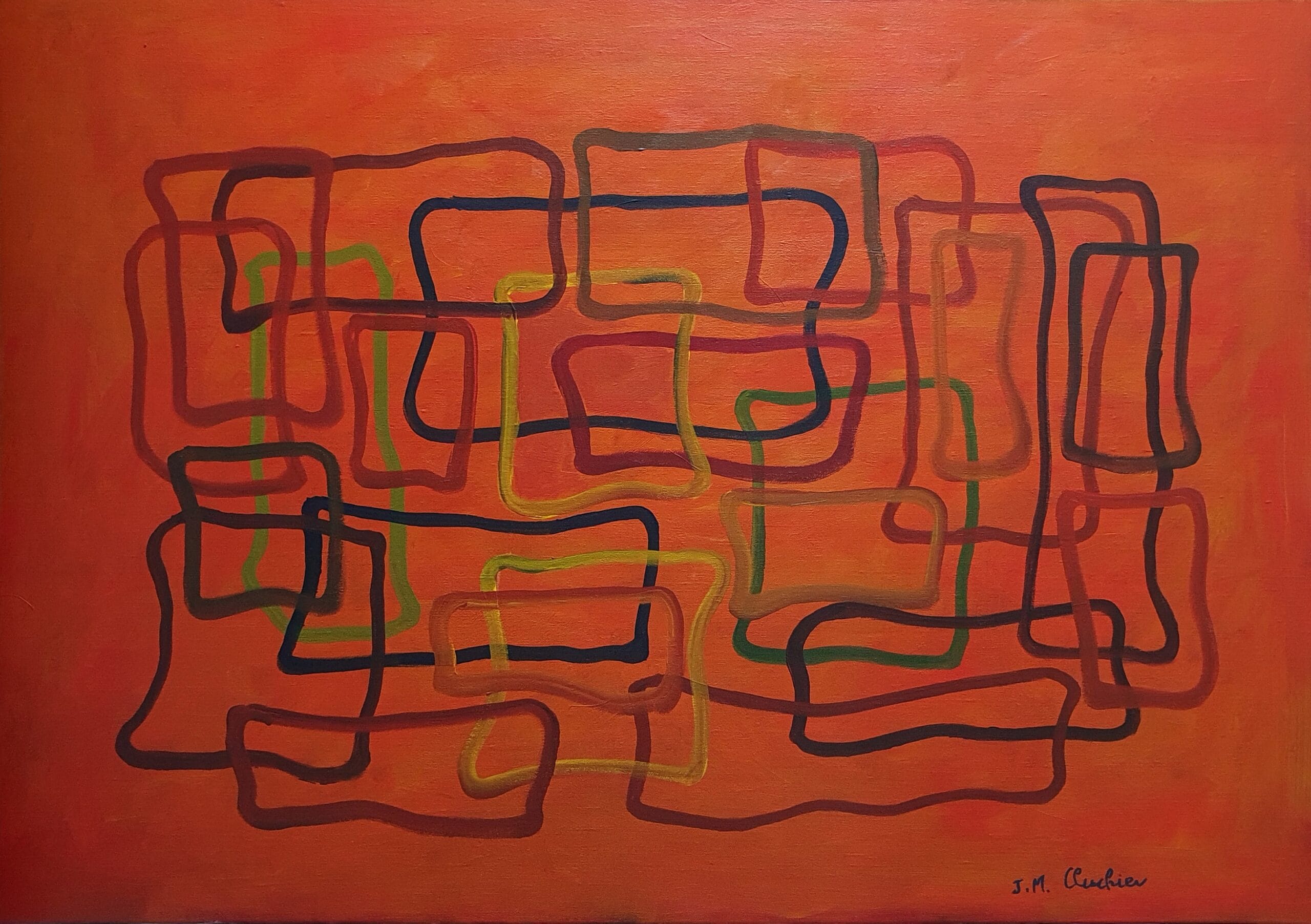
I produce few "series" — that is, paintings sharing the same palette or a very similar composition. My works vary and explore different subjects: landscapes, seascapes, figures, abstraction. My style has changed little over the years. My paintings have few details — forms are suggested rather than stated, integrated into an overall equilibrium. Lighting is carefully considered, and colour transcends reality. My abstract works are founded primarily on geometric forms.
Phase 3: Choosing the chromatic key
There are infinite palette choices for any given subject. Colour conveys an atmosphere, transmitted through the artist's sensibility. I strive to use a palette rooted in reality without copying its visual appearance. The choice of palette depends on my state of mind at the time, but I always give a specific expressive character to a figurative subject.
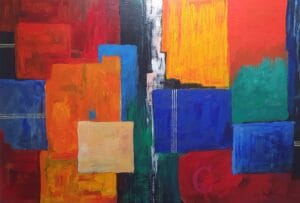
With abstraction, the path is slightly different. The aim is to produce a unique colour composition that exists nowhere else. Abstract painting is creation from nothing: the artist has absolute freedom, extending to the entire palette. The inspiration of the great Masters is indispensable to me, but I detach from it completely at the moment of creation. I do not paint "in the manner of" — that would not be creation. The artist's own signature is essential. Once the idea is firmly set in my mind, I move to production.
Phase 4: Production
The canvas defends its whiteness — but if the conception and chromatic choice phases have been carried through properly, my brushstrokes will follow one another swiftly and the painting will develop quickly.
I paint exclusively in acrylic, a medium increasingly adopted by contemporary artists. The great majority of my colours are created by mixing directly on the canvas with a brush. A few marks are sketched in, the main masses defined in broad terms. Each area of the background is painted quickly, without water or medium. Once the canvas is fully covered, it must already present a balanced image, with harmonious colours aligned with my inner vision.
Once this essential stage is complete, the first details are laid in across each defined area. My work is done with a brush — the strokes remain visible, colours sometimes barely blended. Suggestion takes precedence over detail. I work wet on wet, wet on semi-dry, or dry on wet. I use around ten tubes of colour. Since acrylic dries quickly, speed is essential in the first phase: the chromatic plan must be firmly held in mind from the outset. I also use, though more rarely, acrylic markers for specific effects.
Every stage of the canvas must converge toward the final work. I rarely paint in a single session — alla prima. The greater part of the work takes place in the first session, then the canvas rests in the studio for days or weeks for finishing touches and revisions. This period of visual maturation is essential: it reveals minor imbalances and allows the relationship between the main masses to be refined.
Once complete, the painting is photographed on the easel, signed with an acrylic marker, stamped on the back, and leaves the studio. I never varnish my canvases. In rare cases — increasingly rare with experience — if the final result diverges too far from my original creative vision, the canvas is destroyed. Nothing is more uncomfortable for me than revisiting a work that betrays my intention.
Conclusion
Artistic creation cannot be learned — it is lived and developed day by day. It is the expression of a need to communicate with others, as much as the pleasure of making. Every artist has their own process. There are no rules. Creation is absolute freedom.
To discover my original paintings available for sale: cluchier-art.com