Jean-Marie Cluchier discovered painting as a teenager, but it was from the 1990s that he devoted himself to it regularly and in depth. His artistic approach took a decisive turning point during a significant meeting with the painter R. Escudié on the island of Noirmoutier, who encouraged him to explore creative possibilities more intensely.
Originally from Avignon, he has lived on the Atlantic coast for twenty-five years. He gradually abandoned pastels and watercolors to devote himself entirely to acrylic painting on linen canvas.
His work oscillates between figuration and abstraction, nourished by the careful observation of seascapes, ancient villages and the surrounding nature. Although he pays great attention to composition, it is above all through the power of color and the way in which he restores light that he manages to transmit his inner emotions.
His most recent works move towards a very structured geometric abstraction, in particular around the figure of the triangle, where balanced shapes interact with a palette mixing deep ochres and bright hues.
Marked by 20th century Spanish painting as well as German expressionism, Jean-Marie Cluchier seeks above all to capture atmospheres in perpetual evolution. Whether he paints night seascapes or purely abstract compositions, he cultivates total freedom, refusing any form of rigid or imposed style.
For him, painting remains above all a profound necessity, an essential means of expressing his vision of the world, in which the serenity of the gesture is combined with great chromatic intensity.
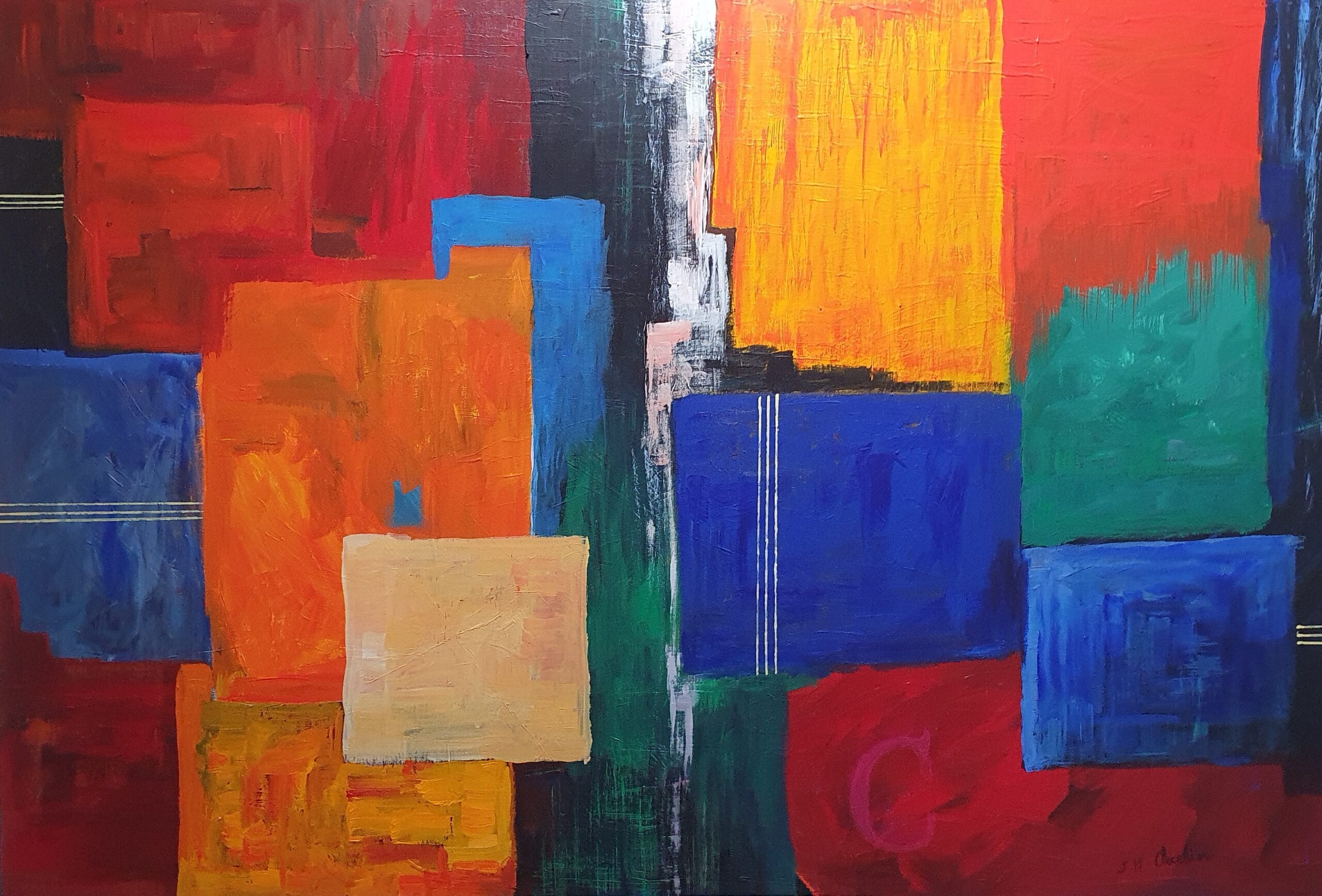
This abstract acrylic painting, signed **J.M. Cluchier** (a self-taught French artist born in 1954, known for his acrylic works on canvas), is a dynamic and bold non-figurative composition dominated by blocks of vivid, contrasting colors layered on an apparently square or rectangular format.
### Overall Composition
The canvas is divided into an irregular grid of rectangular and square geometric shapes of varying sizes, which overlap and intersect, creating a sense of depth and movement. There is no identifiable subject; the work relies entirely on the interplay of colors, textures, and lines to evoke emotions and atmospheres.
### Color Palette
The palette is rich and contrasting, with intense primary and secondary hues:
– Deep reds and oranges dominate the upper and lower areas.
– Bright yellows and oranges bring a luminous energy.
– Blues (from cobalt to navy) and greens (emerald and turquoise) create fresh contrasts.
– Touches of light beige, black, and white (including thin white vertical lines and drips) add neutrality and rhythm.
These colors are applied in thick washes, with clean but sometimes irregular edges, suggesting a palette knife or broad brush technique.
### Textures and Technique
The material is visible and tactile: the acrylic is applied in thick layers (impasto), with evident brushstrokes, scraping, and vertical drips, particularly in the central area where black and white lines descend like streaks. This gives the work a rough and expressive texture, typical of gestural abstraction. Smoother areas contrast with these impasto layers, creating a play of relief.
### Notable Elements
– A central vertical band of black and gray, crossed by white, acts as a structuring axis, dividing the composition into two asymmetrical halves.
– Thin horizontal lines (white or gold) appear on some of the blue blocks, adding a subtle graphic element.
– The signature “J.M. Cluchier” is visible in the lower right corner, in white cursive script on a red background.
### Overall Impression
This work evokes a vibrant and chaotic, almost musical energy, with strong contrasts that generate visual tension. It could suggest themes such as the conflict of emotions, harmony in disorder, or simply the pure joy of color and matter. Typical of lyrical abstraction or abstract expressionism, it invites the viewer to a personal interpretation, free from any figurative reference.
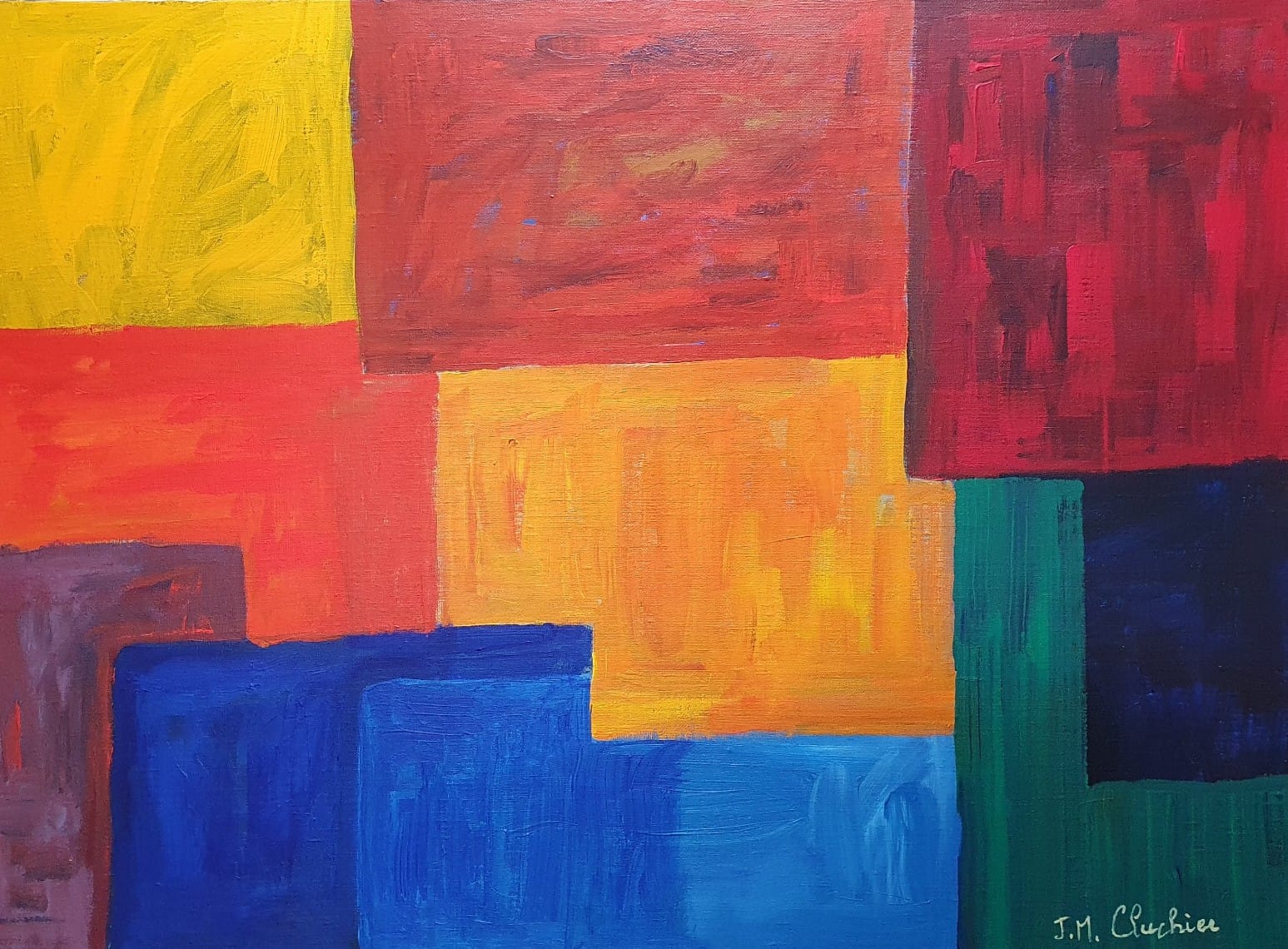
This vibrant composition unfolds as a mosaic of large rectangular blocks in intense, warm colors. The artist organizes the space into a free and asymmetrical architecture: broad swathes of fiery red, solar orange, and lemon yellow dominate the upper portion, while deep areas of ultramarine blue, turquoise, and emerald green anchor the lower part of the canvas. A few touches of dark violet subtly modulate the transitions.
The paint is applied generously: thick brushstrokes, visible impasto, and subtle nuances within each flat area create a living, almost tactile texture. The edges of the forms are never sharp; they overlap, blend, or collide with a contained energy, giving the whole a dynamic breath and an impression of latent movement.
The work radiates an unabashed chromatic joy, evoking both the luminous contrasts of a stylized Mediterranean landscape and the legacy of modern colorists. It celebrates the pure emotional power of pure color, without resorting to figuration.
Signed in the lower right corner, this painting by **J.M. Cluchier** – an artist sensitive to light and vibrant harmonies – invites the viewer’s gaze to wander freely through this generous, colorful space, poised between solar warmth and marine depths. A controlled explosion of vitality and balance.
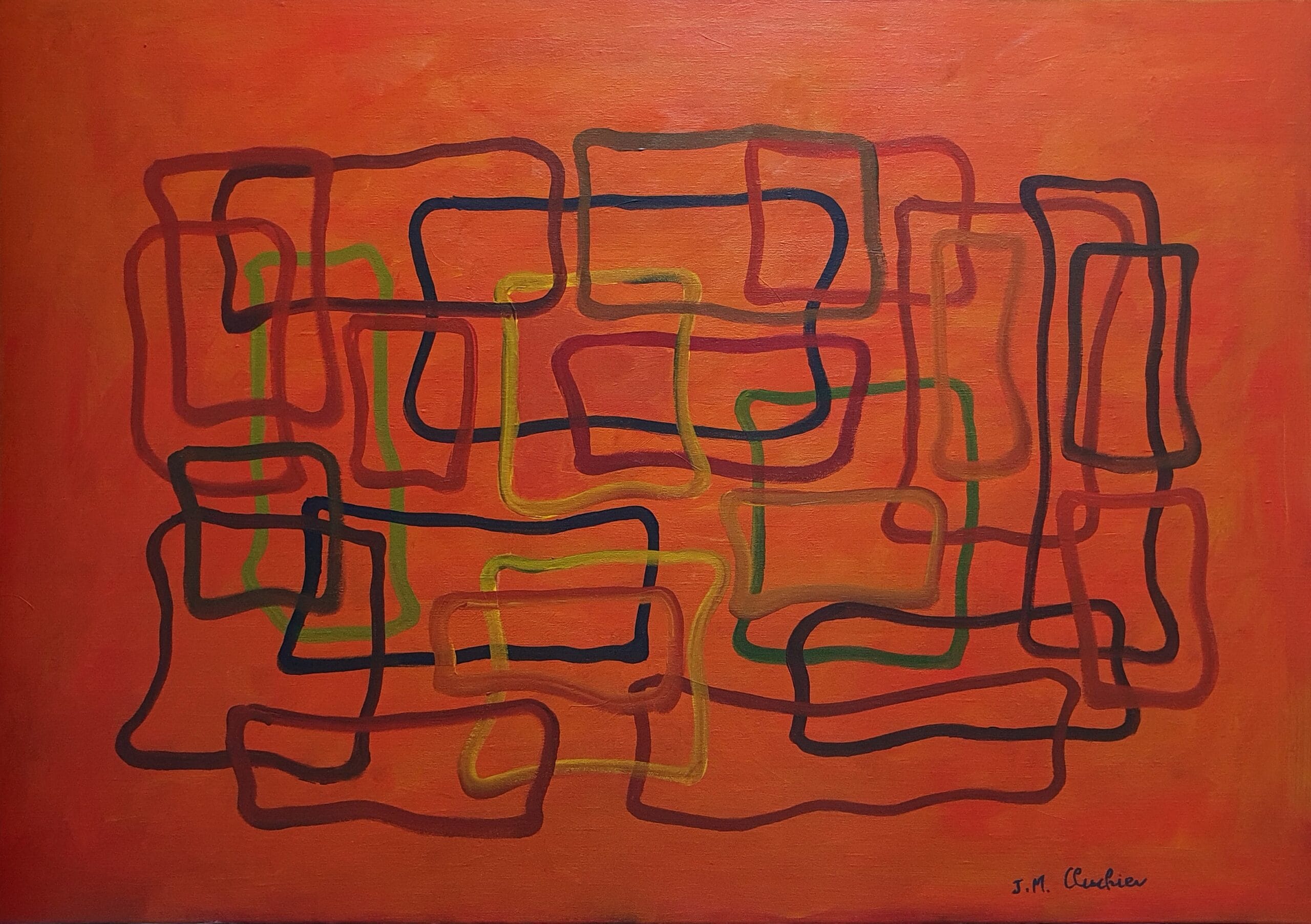
This acrylic painting, signed J.M. Cluchier, presents an abstract composition against a vibrant orange-red background. The work is defined by a complex network of overlapping lines that form a labyrinth on the canvas. These lines, rendered in black, mustard yellow, olive green, and deep red, create a series of irregular, interconnected shapes, suggesting both structure and chaos. The varying thickness of the lines adds depth and rhythm, while their warm, earthy tones contrast with the fiery background, creating a dynamic visual tension. The overall effect is one of movement and energy, as the lines twist and curve, inviting the viewer to explore their intricate paths. The artist’s signature, “J.M. Cluchier,” is carefully inscribed in the lower right corner, anchoring this bold and expressive abstract work.
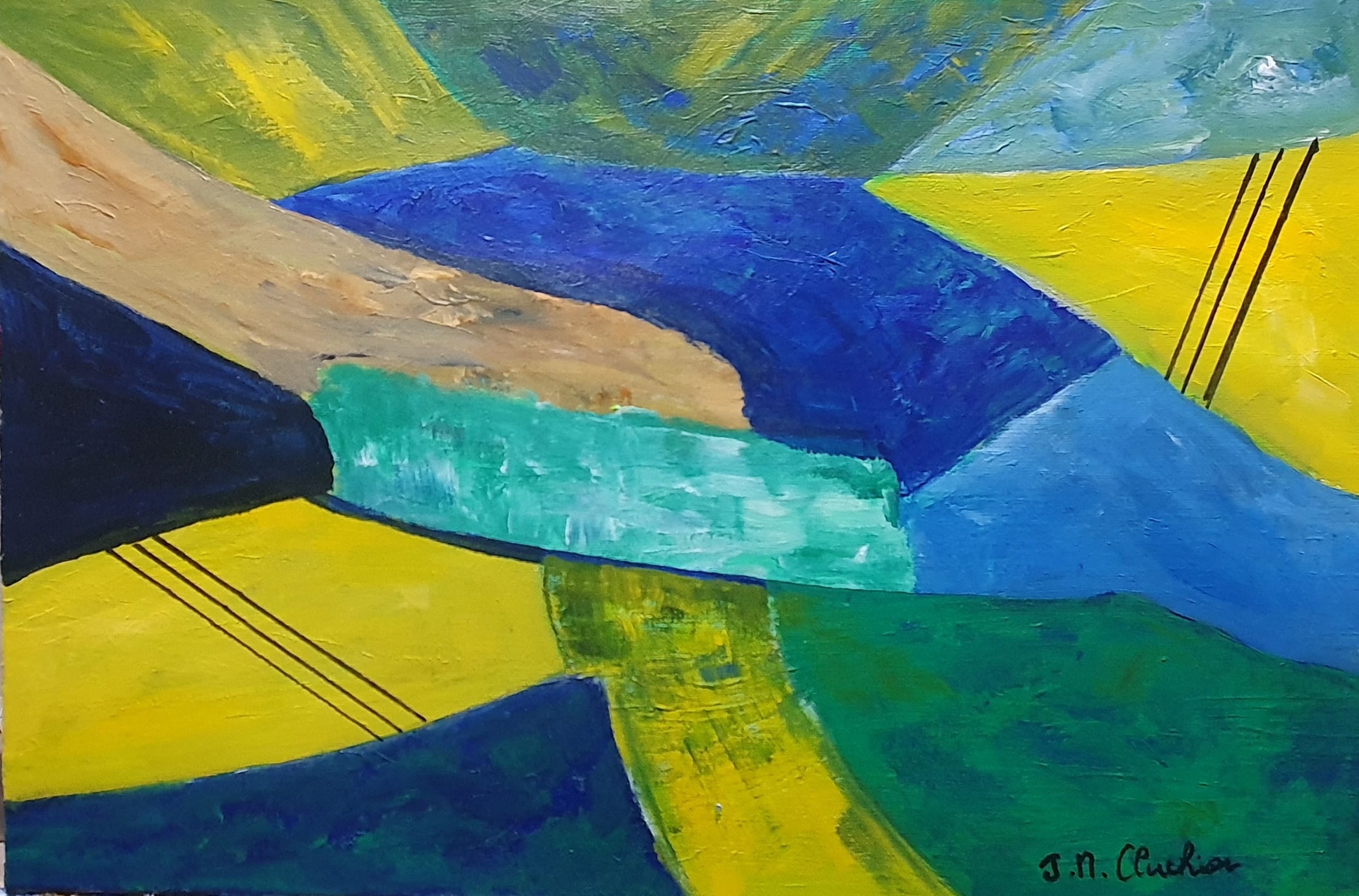
Abstract acrylic painting evoking nature.
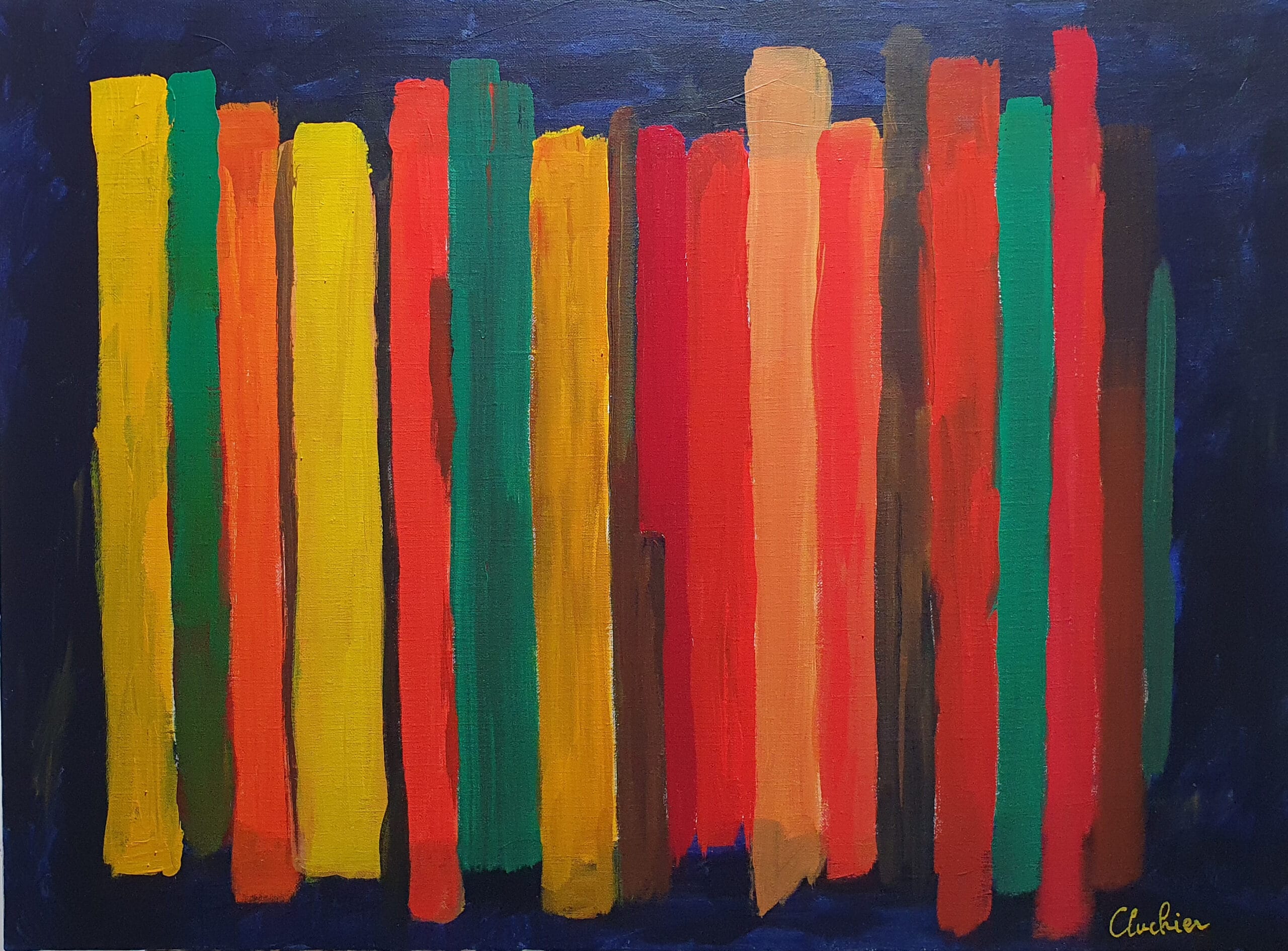
This acrylic on canvas represents an abstraction of a series of multicolored sticks.
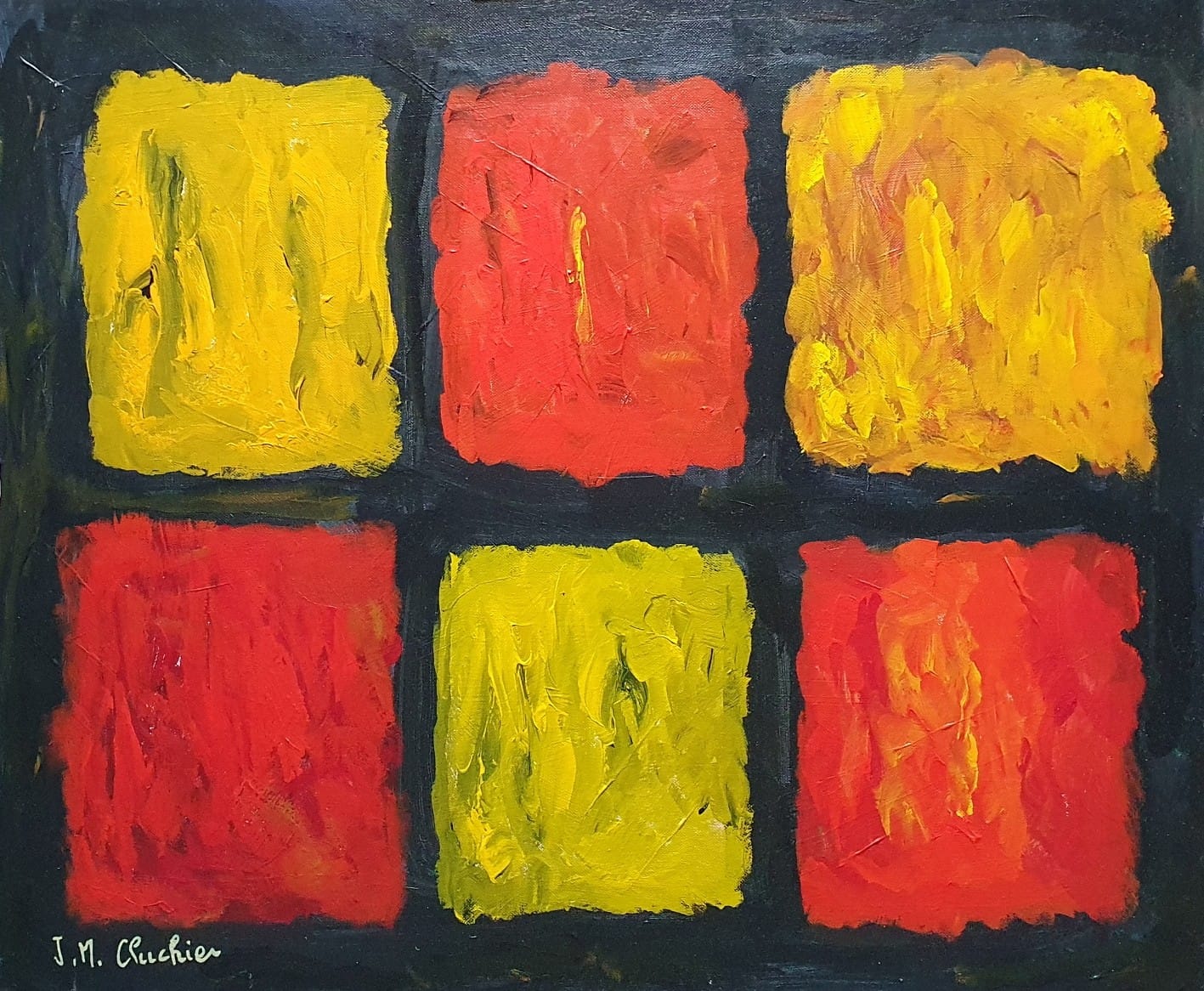
This abstract acrylic on canvas board depicts six red, yellow, and orange squares.
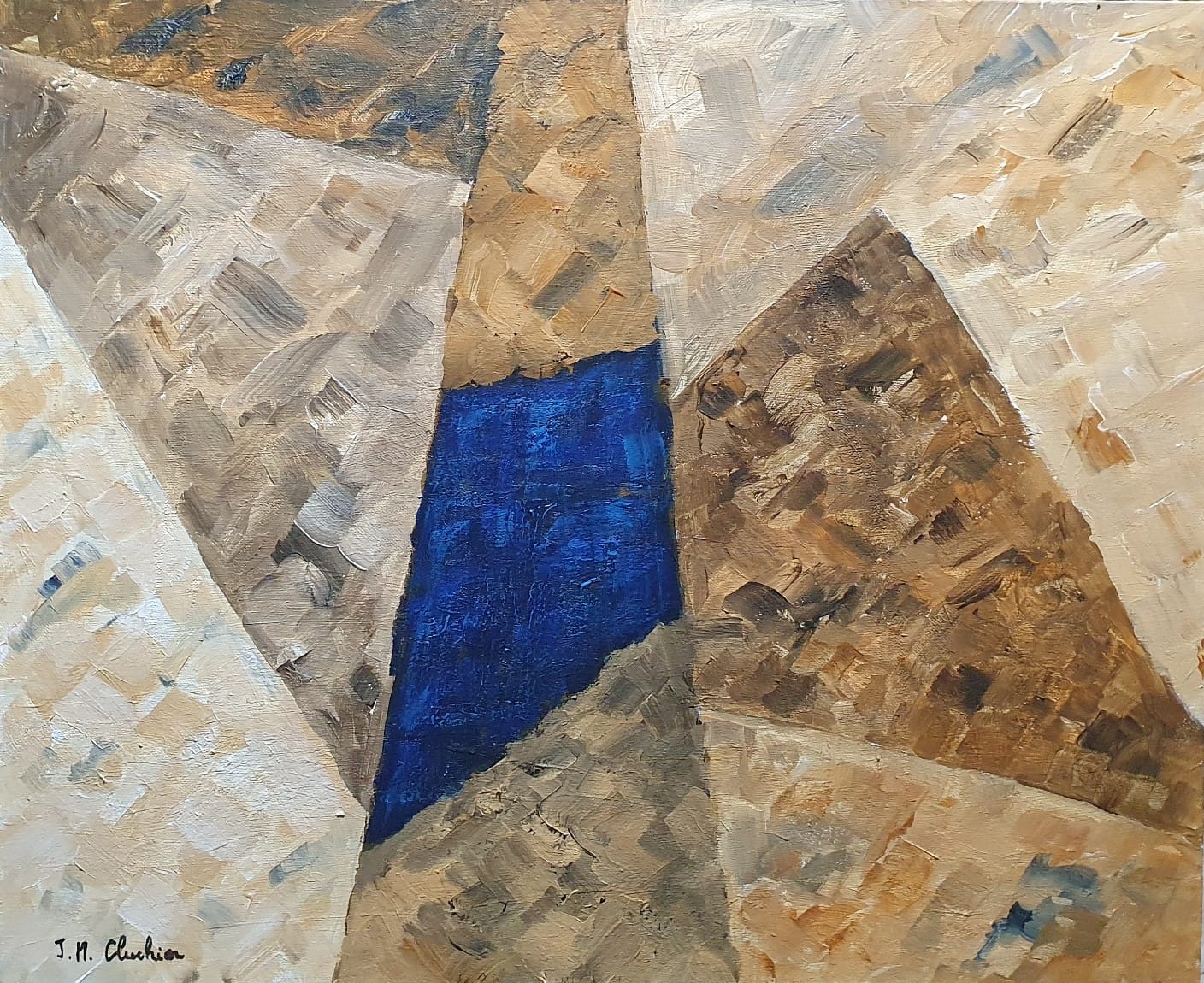
This acrylic painting on canvas, signed J.M. Cluchier in the lower right corner in fluid, slightly slanted black script on a light background, embodies pure geometric abstraction. The triangulation evoked in the title unfolds as an imaginary network of forms in tension, suggesting both a mental map and a fractured architecture. The work presents a textured and dynamic surface, marked by a generous application of paint that lends the whole a tactile, almost sculptural depth. The title, *Abstraction of Imaginary Triangulation*, suggests a conceptual exploration: not a literal triangulation, but an illusion of virtual connections, where forms overlap and superimpose like planes projected into a non-Euclidean space.
The pictorial space is fragmented into a mosaic of irregular polygons, primarily triangular or trapezoidal, which radiate outwards from an implied center, creating a sensation of centrifugal movement. At the heart of the composition sits a dominant blue form, an enlarged trapezoid with sharp but slightly irregular contours, acting as a magnetic pivot. This blue extends vertically across about a third of the canvas’s height, inserting itself like a tectonic fault within a landscape of beige and ochre planes. Around it, the forms are arranged in an asymmetrical network: on the left, a series of tapered triangles in light beige and taupe overlap diagonally, forming a kind of optical staircase that guides the eye upward; on the right, more massive trapezoids in warm brown and pale ochre are stacked horizontally, evoking superimposed geological strata. Below, a broad, stable base in off-white and dark beige anchors the composition, while above, sharp points pierce the horizon, suggesting an escape to infinity. These forms do not always meet at right angles; Subtle negative spaces—white or beige silences—emerge between them, reinforcing the idea of an “imaginary” triangulation, where connections are suggested rather than imposed, inviting the viewer to mentally trace invisible lines of force.
The color palette is dominated by an earthy and neutral range, warm and mineral, evoking the tones of dried clay or an autumnal landscape under a veiled sun: sandy beiges, soft taupes, golden ochres, and coppery browns blend into one another through fluid, almost atmospheric transitions. These warm hues, applied in superimposed layers, create a soothing uniformity, but are abruptly interrupted by the irruption of the central cobalt blue—a deep, matte, velvety blue that vibrates like a vein of azure in ochre rock. This chromatic contrast is the dramatic heart of the work: the blue is not a simple patch, but a textured mass that absorbs and repels light, generating subtle internal shadows and shimmering reflections. The edges of this blue form bleed slightly into the adjacent tones, with minute greenish halos (perhaps turquoise undertones), adding a touch of mystery. Overall, the palette avoids extremes: no absolute blacks or pure whites, but a modulated harmony that exudes restraint, where the blue acts as an emotional counterpoint, introducing an introspective coolness within the enveloping warmth.
The execution is rich and expressive, typical of an oil painting worked with a palette knife and broad brush. The brushstrokes are visible and rough, particularly in the beige and brown areas: thick impasto sculpts the forms, creating reliefs that capture light in varying ways—the ochre peaks seem to protrude under the lighting, while the taupe hollows absorb the shadows. The central blue, on the other hand, is smoother, almost polished in places, with horizontal striations that suggest a fluid modeling, like a resin pour. Cross-brushing marks emerge in the transitions, attesting to an iterative process: the artist likely layered glazes to blend the contours, while leaving the initial layers exposed for a raw authenticity. This haptic texture invites touch as much as sight, reinforcing the abstraction by making it tangible—one can imagine fingers lightly tracing the triangular edges.
In *Abstraction of Imaginary Triangulation*, J.M. Cluchier transcends pure geometry to explore a psychic or cosmic triangulation: these forms evoke neural connections, sketched constellations, or plans of a dreamlike architecture, where the “imaginary” resides in the space between the lines—this fertile interval where the viewer projects their own narrative triangulations. The work does not impose a fixed perspective; on the contrary, it oscillates between flatness and
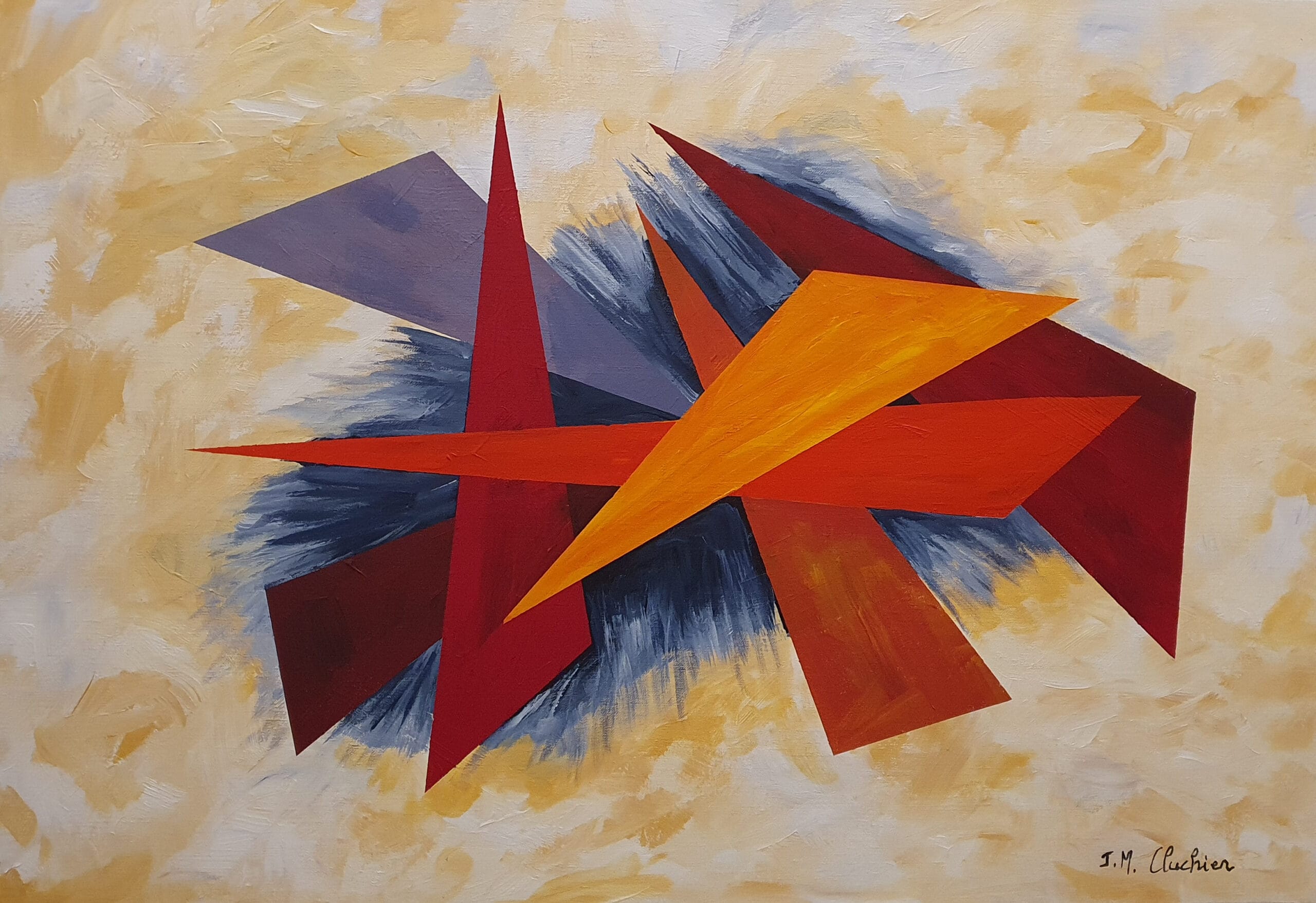
This acrylic painting, signed by the artist “J.M. Cluchier” in the lower right corner, is a vibrant and dynamic abstract composition that showcases a bold use of color and geometric shapes. The artwork measures approximately the size of a standard canvas, though exact dimensions are not provided. The painting features a textured background with a creamy beige and off-white base, layered with soft, sweeping brushstrokes that suggest a sense of movement or atmospheric depth.
The central focus of the piece is a striking arrangement of angular, triangular shapes that overlap and intersect in a seemingly chaotic yet balanced manner. These shapes are rendered in a vivid palette of red, orange, yellow, and purple, with accents of deep blue and maroon. The red triangles, which dominate the composition, vary in shade from bright crimson to darker maroon, creating a sense of depth and contrast. One prominent red triangle stretches diagonally across the center, its sharp point drawing the viewer’s eye, while other red forms extend outward, adding energy and direction to the piece.
Interspersed among the red shapes are bold orange and yellow triangles, which inject warmth and luminosity into the composition. The orange form, positioned toward the upper right, glows with a fiery intensity, while the yellow triangle beneath it adds a complementary brightness. These warm tones contrast beautifully with the cooler hues of purple and blue, which appear in the background and within some of the overlapping shapes. The purple triangle on the left side of the canvas introduces a subtle, calming element, while the blue brushstrokes beneath the central forms suggest a shadowy, almost cloud-like foundation that grounds the composition.
The texture of the painting is a notable feature, with thick, impasto-like applications of paint that give the surface a tactile quality. The brushstrokes are visible, especially in the background, where the creamy beige and white layers are applied with broad, sweeping motions. This textured base contrasts with the flatter, more defined edges of the geometric shapes, enhancing the three-dimensional effect.
Overall, the painting evokes a sense of movement and tension, as if the shapes are colliding or bursting forth from the canvas. The use of bold colors and dynamic composition suggests influences from abstract expressionism or cubism, though the artist’s unique style shines through in the textured background and the harmonious yet energetic interplay of forms. This piece invites viewers to interpret its meaning freely, perhaps seeing it as a representation of an explosion, a natural phenomenon, or an emotional outpouring, depending on their perspective.
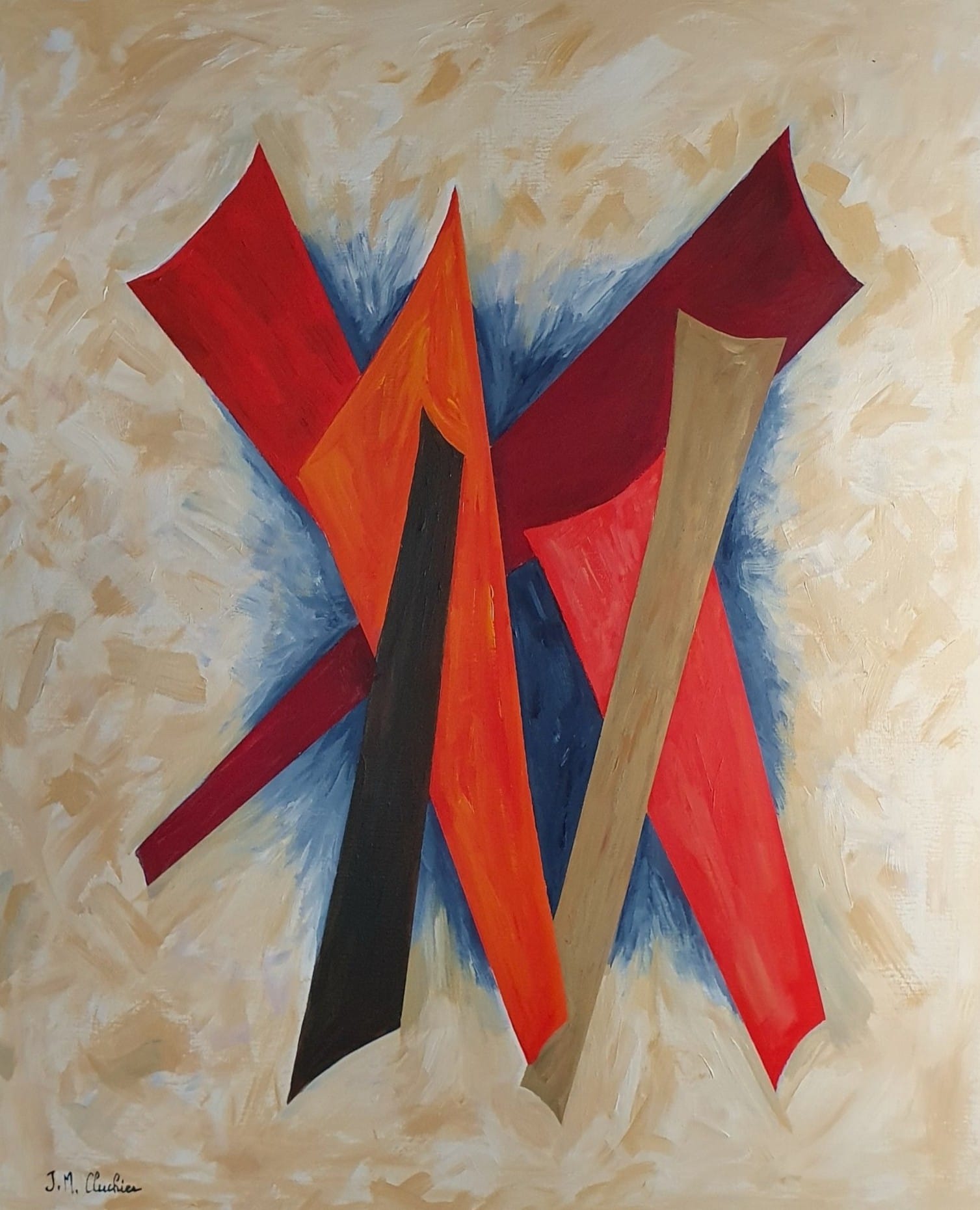
This abstract painting presents a dynamic composition of bold, angular forms. At its center, a series of elongated, intersecting shapes in vibrant colors—red, orange, black, and beige—stand out against a textured background of soft beige and white hues, with touches of blue. These forms, reminiscent of shards or blades, create an impression of movement and tension through their overlapping and diverging, forming a fragmented, almost geometric structure. The red and orange tones dominate, infusing energy and warmth, while the black and beige elements add contrast and depth. The brushstrokes in the background are free and expressive, with subtle blue nuances that enhance the overall impression of depth and movement. The work evokes a modernist style, possibly influenced by Cubism or Futurism, through its emphasis on form, color, and dynamic composition. The interplay of crisp lines and vivid colors creates a striking visual impact, inviting the viewer to explore the relationships between the forms and the emotions they evoke.
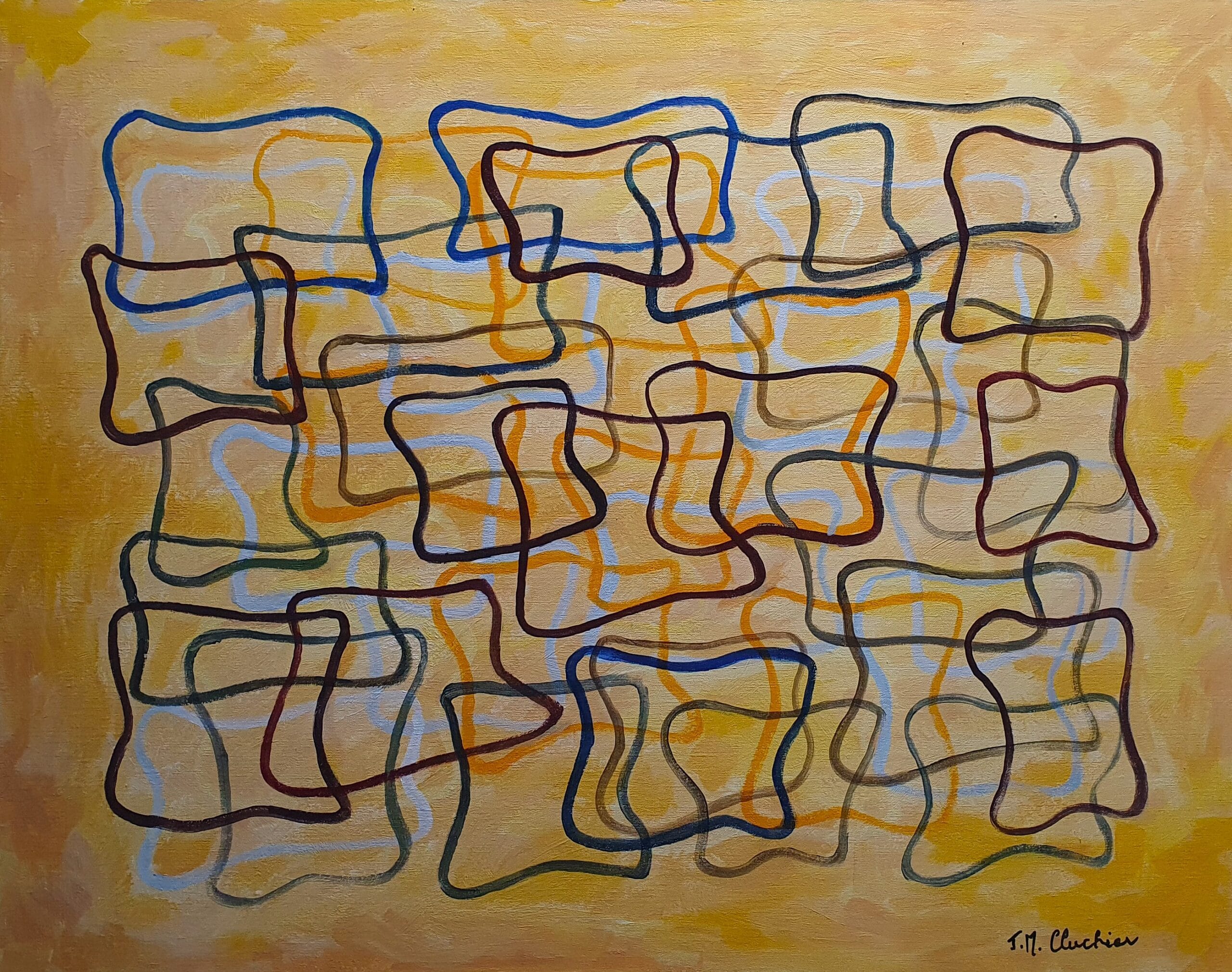
This acrylic painting on canvas, vibrant with contained energy, unfolds a labyrinthine network of interconnected organic forms. Against a warm, luminous background—a soft orangey-gold reminiscent of a Mediterranean twilight or an inner light—the artist traces an interlacing of undulating contours, evoking chains of cells, living puzzles, or stylized neural circuits. The main forms, rounded quadrilaterals with curved edges, fit together like Tetris pieces warped by time, creating an effect of layering and depth.
The contours are emphasized by thick lines in deep blue, reddish-brown, and dark green, which meander fluidly and intersect without ever breaking. These dynamic lines contrast with subtle halos of light blue and pale orange that diffuse a luminous aura, as if the canvas were breathing an inner energy. The work evokes a precarious balance between order and chaos, between confinement and expansion, where each form seems simultaneously isolated and connected to its neighbors.
Signed in the lower right corner, this abstract work by J.M. Cluchier—an artist passionate about light and color—invites meditative contemplation. It suggests invisible connections, networks of thought, or inner landscapes, within a warm and enveloping chromatic harmony. A work that captivates with its visual rhythm and joyful serenity.
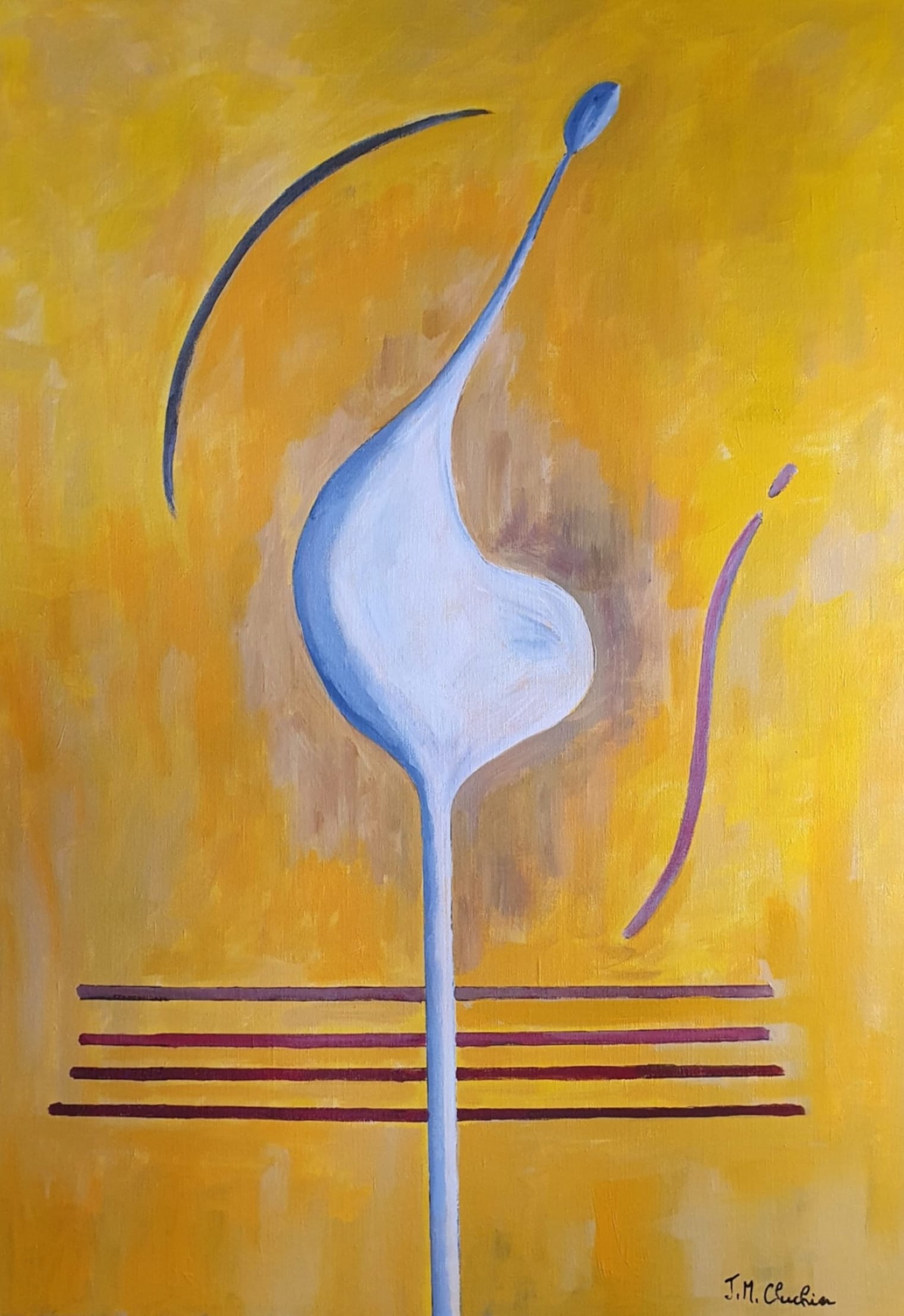
This abstract painting, signed “J.M. Cluchier” in the lower right corner, presents a minimalist composition against a vibrant yellow background. At its center, an elongated, pale blue form rises vertically, evoking a stylized flame or teardrop, with a narrow base and a wider, rounded top. Five horizontal brown lines cross this form near its base, creating a rhythmic, ladder-like pattern that structures the composition’s fluidity. A thin brown line curves gracefully to the right, echoing the contour of the central form, while a semicircular black line sweeps across the upper left corner, suggesting movement. The background, painted in a warm yellow with subtle variations in texture, provides a luminous contrast to the cooler blue and brown elements, enhancing the work’s visual impact. The simplicity of the composition and the boldness of the colors and forms evoke mid-20th-century abstraction, perhaps recalling artists like Joan Miró, with his playful yet assertive shapes. The painting evokes a sense of balance and elegance, inviting viewers to interpret the central form as a symbol of growth, aspiration, or fluidity.
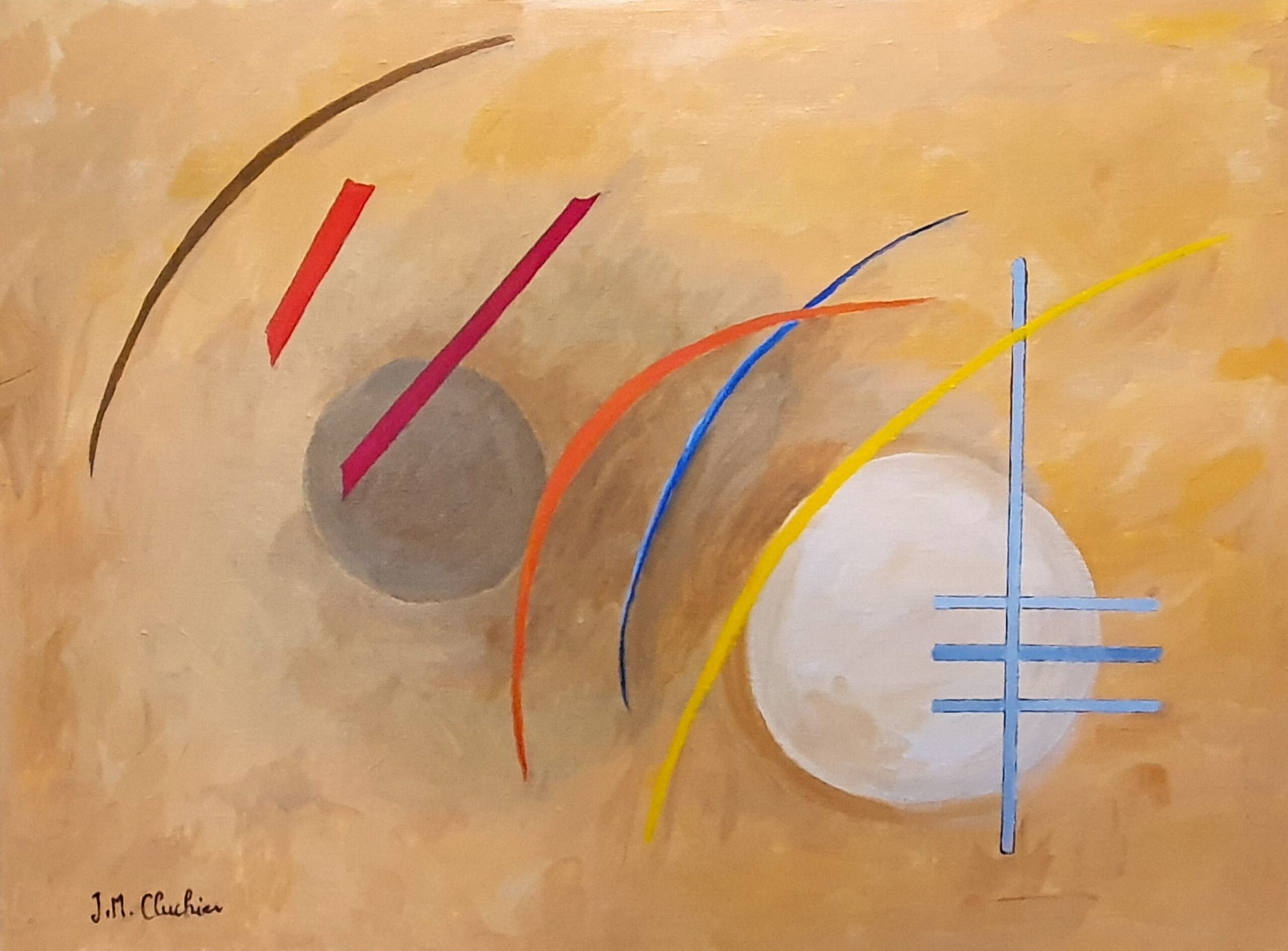
This abstract painting, signed “J.M. Cluchier” in the bottom left corner, features a minimalist yet dynamic composition set against a textured beige background. The canvas is dominated by two circular forms: a gray circle on the left and a white circle on the right, each intersected by bold, curving lines in red, orange, blue, and yellow. The gray circle is bisected by a thick red line, while the white circle is marked with a blue grid-like structure, adding a sense of order amidst the fluidity of the surrounding lines. These lines, varying in thickness and color, sweep across the canvas in graceful arcs, creating a sense of motion and rhythm. The background’s earthy tones, with subtle variations in texture, provide a warm contrast to the vibrant lines and shapes, grounding the composition. The painting’s style echoes the influence of early 20th-century abstraction, possibly drawing from movements like Suprematism or Constructivism, with its focus on geometric forms and dynamic lines. The interplay of color, shape, and line creates a balanced yet energetic visual experience, inviting viewers to explore the tension between structure and freedom.
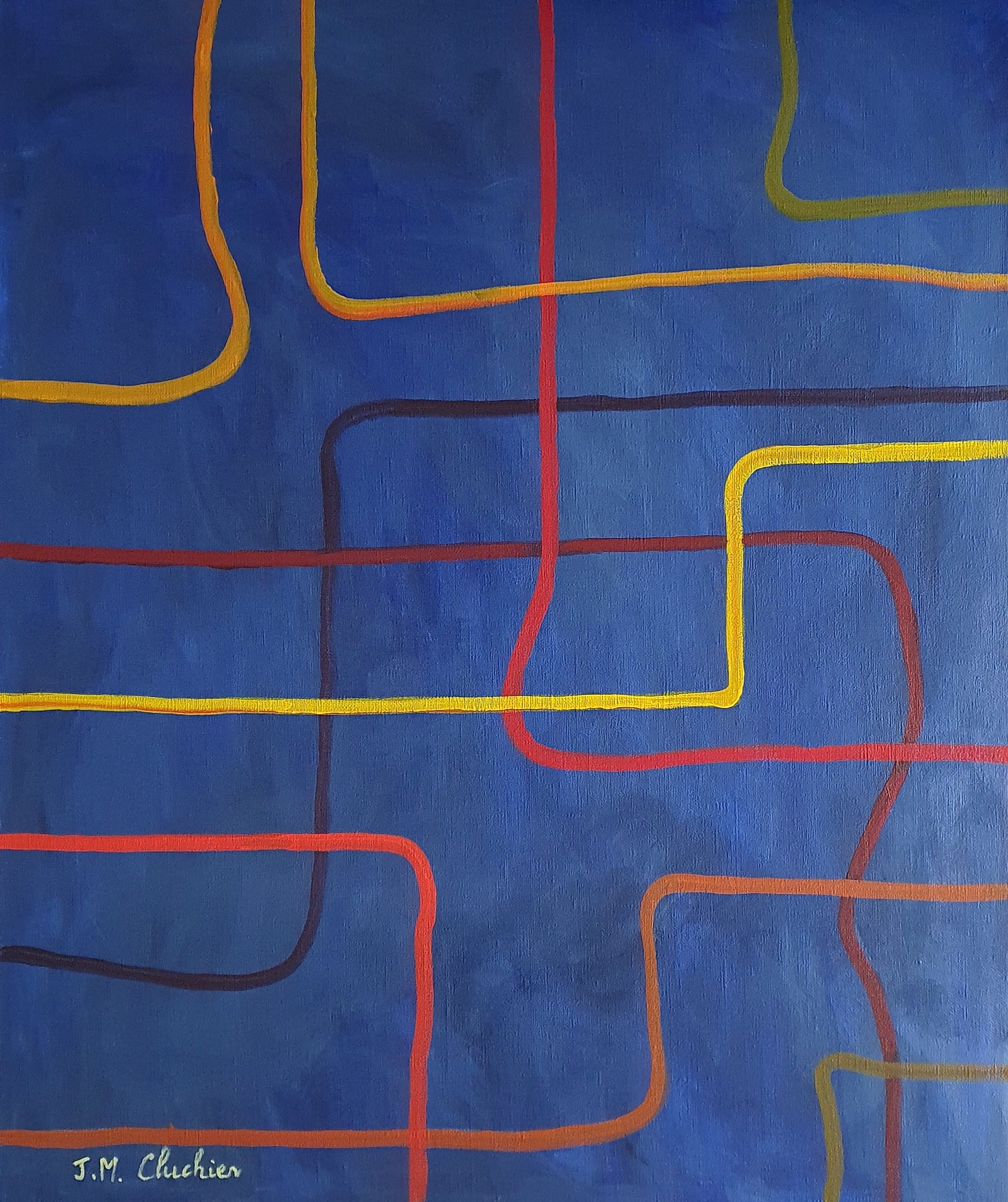
This acrylic painting, signed “J.M. Cluchier” in the bottom left corner, features an abstract composition set against a deep blue background. The artwork is characterized by a series of overlapping, curvilinear lines that create a maze-like pattern. These lines, painted in bold colors—red, yellow, green, and dark blue—intersect and weave through one another, forming irregular shapes and enclosed spaces. The lines vary in thickness, adding a sense of depth and movement to the piece. The red lines are particularly striking, often dominating the composition with their intensity, while the yellow and green lines provide contrast and balance. The dark blue lines blend subtly with the background, creating a cohesive yet dynamic visual effect. The overall style is reminiscent of mid-20th-century abstract art, with influences that might recall the works of artists like Wassily Kandinsky or Joan Miró, emphasizing rhythm, color, and form over representational content. The painting evokes a sense of organized chaos, inviting viewers to trace the paths of the lines and explore the relationships between the shapes they create.
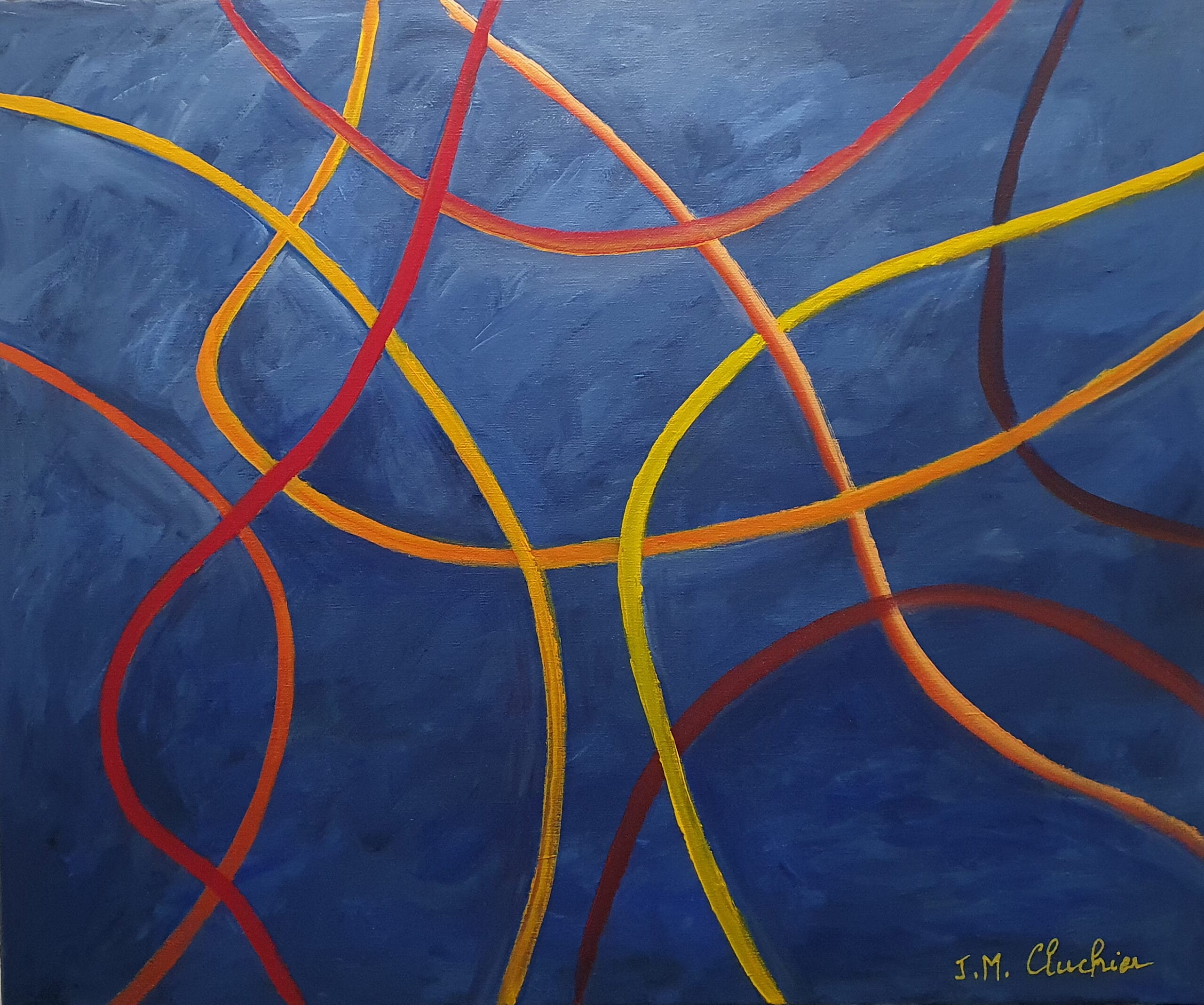
Colored lines on a dark blue background; this abstract painting has a spatial and nocturnal feel.
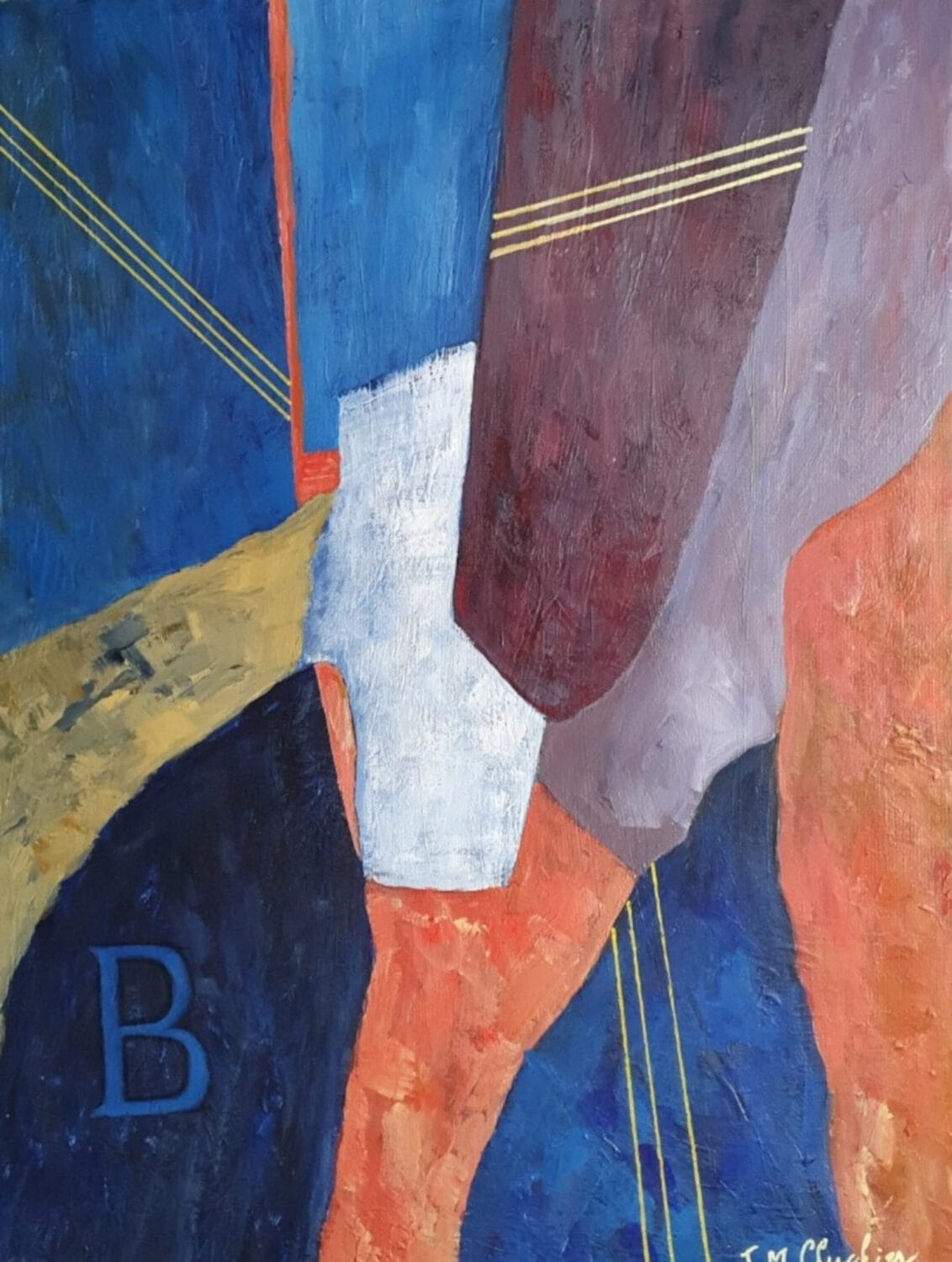
This abstract painting presents a striking composition dominated by deep blue tones. The canvas reveals a series of irregular, overlapping shapes in shades of blue, burgundy, orange, and beige, contrasting sharply with a central white form. The bold, angular shapes create a sense of depth and movement through their intersections and folds. Thin yellow lines traverse the composition diagonally, adding a delicate linear touch that contrasts with the thicker, textured brushstrokes of the main forms. A clearly visible blue “B” is painted in the lower left corner, creating a subtle focal point. The rich, textured blue background contains lighter shades that suggest layering and dimension. The overall effect is one of controlled chaos, where the interplay of color and form evokes a modernist aesthetic, perhaps drawing inspiration from movements such as Abstract Expressionism or Constructivism. The painting’s dynamic energy and cool palette invite the viewer to explore its emotional and structural complexity.