Where Does a Painter's Inspiration Come From?
Three Masters Who Shaped My Eye and My Palette
By Jean-Marie Cluchier | Painting & Inspirations
A painter's inspiration never emerges from nothing. It builds slowly, through museums wandered, catalogues leafed through late at night, canvases that stop you in your tracks and simply refuse to let you go. For me, three painters have played that decisive role: Emil Nolde, whose blazing colours still inhabit every seascape and bouquet I paint; Serge Poliakoff, whose spare geometry continues to guide my abstract compositions; and Joaquim Mir Trinxet, the Spanish landscapist whose freedom of brushwork laid the foundations of my approach to nature for more than fifteen years. This article is my way of paying them tribute — and of explaining, concretely, how they still live in my work today.
Primary influence
Emil Nolde — The Man Who Set Colour on Fire
A life at the edge of the world
Emil Hansen was born in 1867 in Nolde, a small village on the German-Danish border, and adopted the village's name as his artistic pseudonym — a founding act that says everything about his bond with the land and the elements. He grew up in an austere, wind-swept environment, and that inner geography never left him: it would leave its mark in every turbulent sky, every storm-tossed sea he ever painted.
His training was late and scattered. He studied in Munich, Paris, and Copenhagen, but remained essentially self-taught in his relationship with colour. In 1906 he briefly joined Die Brücke, the Expressionist group in Dresden, before drifting away — too independent to belong to any school. By the 1910s he was already recognised as one of the most singular voices in German Expressionism.
His life took a dark turn under the Third Reich. Nolde naively joined the Nazi party in the 1930s, believing his Nordic nationalism would earn him official recognition. The result was the opposite: in 1937, his works were exhibited in the notorious Degenerate Art show (Entartete Kunst) — the greatest humiliation an artist could suffer in Hitler's Germany. In 1941 he was forbidden to paint outright. He responded by secretly producing a series of miniature watercolours he called his "Unpainted Pictures" (Ungemalte Bilder) — small, intense works kept hidden in drawers, so many silent acts of resistance. He died in Germany in 1956, aged 88, rehabilitated and laden with belated honours.
Nolde's art: blazing colours, spirituality and freedom
What immediately distinguishes Nolde's work is a chromatic intensity that feels almost physical in its violence. Where his Impressionist contemporaries sought light as it settles on objects, Nolde sought colour as it lives inside him — an interior, emotional colour that obeys no optical reality but answers to a psychic truth.
His oil paintings are dense, loaded, applied with a raw confidence. Contours dissolve, forms ignite. In his religious works — he painted biblical scenes with an almost mystical fervour — the faces are distorted, the colours hallucinatory. In his Schleswig-Holstein landscapes, skies glow orange and violet at intensities nature itself never quite reaches; seas roll in deep blue-green masses rimmed with black.
His watercolours may be the most electrifying dimension of his work. Nolde mastered the wet-on-wet technique: he applied colour onto paper still saturated with water and allowed the pigments to expand, merge, and surprise one another. He did not control — he accompanied. Nolde's flowers (tulips, poppies, anemones) achieve an almost abstract intensity: they are less botanical representations than chromatic explosions, vegetable states of mind.
"Colours delight me, and colours haunt me."
— Emil Nolde
Three major works
- "Seebüll" (1930) — View of the artist's home by the North Sea, monumental Expressionist sky. Estimate: €800,000 – €2M.
- "Großer Mohn" (Large Poppy, 1942) — An emblematic watercolour, a red explosion against a dark ground. Estimate: €300,000 – €700,000.
- "Das Meer" (The Sea, 1930) — Oil seascape in deep blue-green tones of exceptional dramatic power. Estimate: €1M – €3M.
His legacy and influence on modern painting
Nolde is one of the rare artists to have pushed colour to its breaking point — the place where it ceases to describe and becomes expressive in its purest state. That conquest opened the door to American Abstract Expressionism in the 1940s and 1950s. Mark Rothko, whose colour fields vibrate with comparable emotion, implicitly acknowledges that debt. Closer to the present, many contemporary painters who treat colour as emotional matter claim this lineage.
His works can be seen in the world's great collections: the Nolde Museum in Seebüll (Germany) is entirely dedicated to him, and his canvases are also held at the Museum of Modern Art in New York, the Städel in Frankfurt, the Kunstmuseum Basel, the Hamburger Kunsthalle, and the Centre Pompidou in Paris.
What Nolde taught me
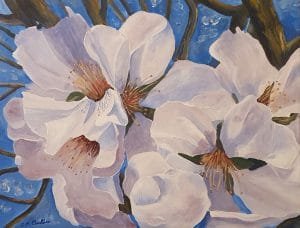
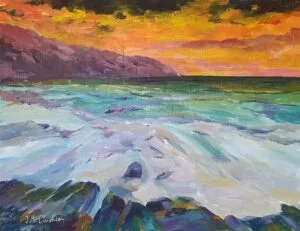
It was in his nocturnal seascapes that I first encountered Nolde — those dark waters crossed by improbable bursts of light, those horizons that seem to burn from within. I understood that colour need not reproduce what the eye sees, but say what the soul feels when facing a landscape. That freedom liberated me. Today, when I paint a bouquet or a seascape, I choose my colours not for their optical truth, but for their emotional truth.
→ Discover my paintings inspired by Nolde at cluchier-art.com
Abstraction
Serge Poliakoff — Geometry as the Language of the Soul
From a Russian cabaret to the walls of the world's museums
Born in Moscow in 1900 into a prosperous merchant family, Serge Poliakoff fled the Russian Revolution as a teenager and crossed Europe — from Constantinople to Berlin, from London to Paris. He survived by playing guitar in cabarets and restaurants, a bohemian lifestyle that lasted into his thirties. It was in Paris, where he settled permanently in 1923, that he began to paint seriously, attending the École des Beaux-Arts and meeting figures who would prove crucial: Wassily Kandinsky, whose theory of colour-as-sound left a deep mark, and Robert and Sonia Delaunay, who initiated him into the constructive power of abstraction.
His conversion to total abstraction was gradual but irreversible. By the 1950s he had found his definitive language: pure colour planes with irregular but sovereign outlines, interlocking like the pieces of an interior puzzle. Recognition came swiftly — Grand Prize at the Ljubljana Biennial in 1967, retrospectives in major European museums. He died in Paris in 1969.
Painting as silent architecture
What strikes the viewer in Poliakoff's canvases is their paradoxical equilibrium: simple shapes — irregular polygons, never symmetrical — producing a sophisticated visual tension. There is no narrative, no gesture, no thick impasto. Only colour and form in their most naked relationship. Poliakoff works his grounds so that light seems to come from within the canvas rather than from its surface.
His palette is characteristic: ochre, brick red, olive green, black and off-white succeed one another in chords one might describe as muted — never shrill, always deep. He sought what he himself called the right accord between colours, the way a musician seeks a harmony.
His influence reaches well beyond painting. The couturier Yves Saint Laurent, a declared admirer, drew directly on Poliakoff's colour planes for his iconic dresses of the 1960s and 1970s — notably the celebrated 1965 Mondrian dress, whose geometric spirit owes as much to Poliakoff as to De Stijl.
Three representative works
- "Abstract Composition" (1954) — Red, ochre and black planes, an exemplary balance from his mature period. Estimate: €400,000 – €1M.
- "Red Composition" (1960) — Brick-red dominant, large-format canvas. Estimate: €600,000 – €1.5M.
- "Blue and Green Composition" (1963) — Reveals his sensitivity to cool chords, rarely exhibited. Estimate: €300,000 – €800,000.
His canvases can be admired at the Centre Pompidou in Paris, the Kunstmuseum Bern, the Museum Ludwig in Cologne, and the Musée d'Art Moderne de la Ville de Paris.
Poliakoff in my abstract work
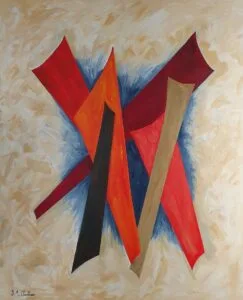
With every abstract composition I make, I find Poliakoff again. Not as a model to imitate, but as a frame of thought. Even before putting brush to canvas, I am already searching for that equilibrium between masses of colour: which form will breathe, which will anchor, how will the whole hold together without narrative or anecdote. It was he who taught me that abstraction is not chaos — it is an invisible architecture.
→ View my abstract paintings at cluchier-art.com
Landscape
Joaquim Mir Trinxet — The Painter Who Made the Mediterranean Sing
The finest landscapist of his time
Born in Barcelona in 1873 and died in 1940, Joaquim Mir Trinxet is regarded by Spanish and Catalan critics as the greatest landscapist in modern Spanish painting. Trained at the Barcelona School of Fine Arts, he became part of the Els Quatre Gats circle — the café-studio that welcomed a young Pablo Picasso, Ramón Casas, and other figures of Catalan Modernisme. But Mir was not an indoor painter: it was wild nature that obsessed him.
A decisive stay in Majorca (1901–1904) permanently transformed his work. Confronted with Mediterranean light, explosive vegetation, ochre rock and electrically blue water, he adopted a palette of richness and audacity found nowhere else in Spanish painting of the period. Forms simplified, brushstrokes freed themselves, and the canvas became the site of a direct confrontation between the painter and the light.
Three representative works
- "La Cala Encantada" (The Enchanted Cove, 1903) — Masterpiece of his Majorcan period, colours of an almost Fauvist intensity. Museu Nacional d'Art de Catalunya (MNAC), Barcelona.
- "El Torrent de Pareis" (1903) — Mediterranean gorge, a vertiginous composition between rock and vegetation. MNAC, Barcelona.
- "Jardín de Camp de Mar" (c. 1905) — Explosive vegetation in blazing colours. Private collections and Spanish regional museums.
His canvases are held principally at the Museu Nacional d'Art de Catalunya in Barcelona and the Museu de Montserrat.
Mir Trinxet and my figurative landscapes
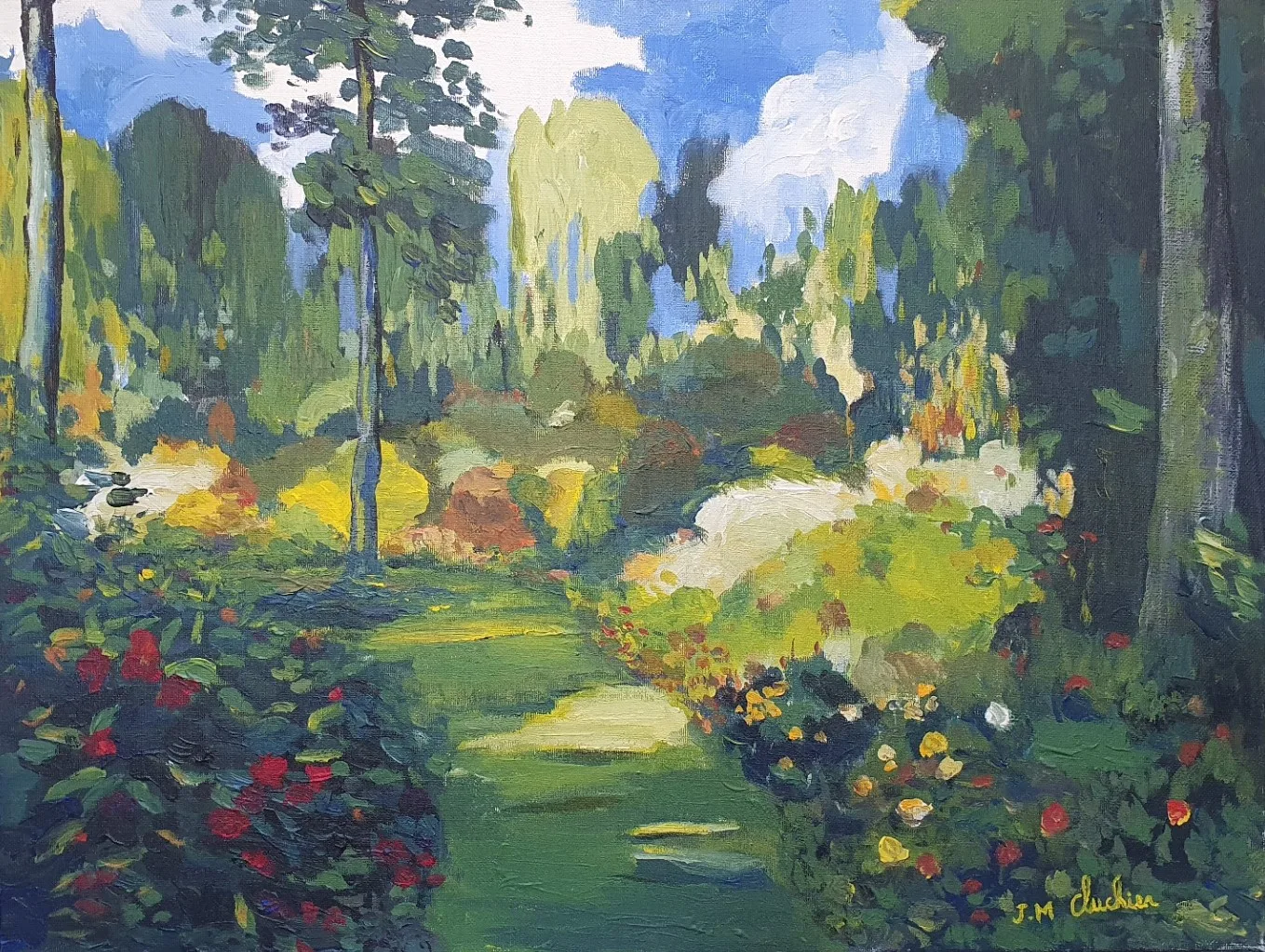
For more than fifteen years, Mir was my compass when I painted nature. His ability to capture Mediterranean light with colours that seem impossible — a violet for a shadow, a burning orange for a pebble — and his way of simplifying forms without impoverishing them left a deep mark on me. He taught me that fidelity to a landscape is not a matter of resemblance but of exact emotion.
→ View my figurative works at cluchier-art.com
Inspiration: a conversation across time
Nolde, Poliakoff, Mir Trinxet — three radically different universes, yet a single thread running through all three: each refused to paint what he saw in favour of what he felt. Colour as emotion in Nolde, form as silence in Poliakoff, light as vibration in Mir. These three visions have accompanied me since the beginning and continue to nourish my work — differently with each series, differently with each season.
Inspiration is not copying. It is a silent dialogue with works that have resonated inside you, once, and that go on resonating long after. These three painters changed the way I look at the world — and therefore the way I paint it.