At the origins of a movement that transformed my way of painting
By J.M. Cluchier – Contemporary painter – 2026
What is Expressionism?
There are artistic movements that don’t seek to depict the world as it is, but as it is felt. German Expressionism is one of them—perhaps the most radical, the most heart-wrenching, and, for me, the most foundational. Born at the turn of the 20th century in a Wilhelmine Empire rife with social and political tension, this movement opposed the imitation of reality with a fierce desire to translate inner states: anguish, solitude, ecstasy, violence.
Unlike Impressionism, which captured the luminous vibrations of nature, Expressionism distorts, amplifies, exaggerates—not through technical incapacity, but out of emotional necessity. The canvas is no longer a mirror; it is a seismograph of the soul.
“Expressionist art does not reproduce the visible; it makes visible.” — Paul Klee
This movement has its roots in the works of Van Gogh, Munch, and Ensor, but it truly flourished in Germany between 1905 and 1933. There, it found fertile ground: a modernity experienced as trauma, brutal urbanization, and the growing shadow of impending catastrophes.
History of a Fragmented Movement
Die Brücke — The Bridge to Rupture (1905–1913)
It all began in Dresden in 1905, when four architecture students—Ernst Ludwig Kirchner, Fritz Bleyl, Erich Heckel, and Karl Schmidt-Rottluff—founded the group Die Brücke (“The Bridge”). Their ambition: to bridge the gap between the academic past and an artistic future free from all formal constraints. They worked with an almost physical urgency, painting on rough wood, carving expressive engravings, and multiplying broken angles and acidic colors. Nolde briefly joined them, without ever truly becoming part of the group.
Der Blaue Reiter — Spirituality in Color (1911–1914)
In Munich, a completely different sensibility emerged with Der Blaue Reiter (“The Blue Rider”), founded by Wassily Kandinsky and Franz Marc. Here, the approach was less visceral, more contemplative and spiritual. Color was no longer a cry but a resonance, an inner vibration. Marc painted animals in unreal hues; Kandinsky moved toward total abstraction. Alexej von Jawlensky, a major figure in this circle, developed a painting of the human face of unparalleled mystical intensity.
Rhenish Expressionism and New Objectivity
After the First World War, a darker and more critical vein developed with painters such as Max Beckmann, Otto Dix, and George Grosz. Direct witnesses to the trenches, they returned with images of mutilated bodies, a corrupt society, and disillusioned humanity. This is sometimes referred to as Neue Sachlichkeit (New Objectivity)—a colder, more documentary inflection, brutal in its expressive realism.
Vienna: Kokoschka and Schiele, Eroticism and Terror
Fin-de-siècle Vienna, permeated by Freudian theories and the anxiety of Austro-Hungarian decline, also produced two giants: Oskar Kokoschka and Egon Schiele. Their portraits seem to burn from within; bodies contort, faces grimace an unspeakable inner truth. Schiele, who died at 28 from the Spanish flu, left behind a searing and unfinished body of work that would haunt all 20th-century painters.
The Nazi Ordeal: Degenerate Art
In 1933, the rise of Nazism brought this artistic adventure to a brutal end. In 1937, the Nazis organized the infamous Entartete Kunst (“Degenerate Art”) exhibition in Munich, displaying 650 Expressionist works seized from German museums to ridicule them in the eyes of the public. Nolde, despite initially being a Nazi sympathizer, had his paintings confiscated. Kirchner committed suicide in Switzerland. Beckmann fled to the Netherlands, then to the United States. For an entire generation, it was exile or death.
The Characteristics of a Painting on the Brink
Recognizing an Expressionist work is not a matter of chance. Several formal traits define it, often in dramatic tension with one another:
The radical simplification of forms. Anecdotal details are eliminated to reach the expressive essence. A face can be reduced to a few lines, a body to a taut silhouette, a landscape to opposing chromatic masses. It is an economy of means in service of maximum power.
Colors as an autonomous language. The Expressionist palette does not obey the laws of natural light. The sky can be blood red, the face green, the shadows violet. Each tone carries an emotional charge. The harmonies are often vibrant, even dissonant, creating tensions that the eye cannot calmly resolve.
The emotional distortion of perspective. The Euclidean geometry of the real world is twisted according to the needs of expression. The proportions of bodies and faces are exaggerated, buildings lean, space contracts or expands. In Kirchner’s work, passersby on Berlin streets seem trapped in a hallucinatory corridor.
The very substance of the paint itself. The brushstrokes are often visible, thick, urgent. The layering of paint creates chromatic vibrations, areas where colors collide and reactivate one another. The painting doesn’t try to be invisible—it asserts itself.
An emblematic example of these principles is Kirchner’s The Street (1913): spectral figures in acidic hues in a nocturnal Berlin, compressed space, empty stares. Or Schiele’s self-portraits, where the fragmented body bears witness to a devastating introspection.
Major Figures of the Movement
Ernst Ludwig Kirchner 1880–1938 · Die Brücke Founder, painter of cities and modern anxieties
Franz Marc 1880–1916 · Der Blaue Reiter Symbolic colors, animals as mirrors of the soul
Alexej von Jawlensky 1864–1941 · Der Blaue Reiter Meditative faces, mystical color fusion
Max Beckmann 1884–1950 · New Objectivity Allegorical triptychs, scathing social critique
Otto Dix 1891–1969 · New Objectivity War painter, embracing human ugliness
Oskar Kokoschka 1886–1980 · Vienna Psychological portraits, tormented landscapes
Egon Schiele 1890–1918 · Vienna Gaunt figures, existential eroticism
Emil Nolde 1867–1956 · Solitary: Incandescent Colors, Religious and Marine Subjects
Emil Nolde — The Painter Who Changed My Painting
1867–1956
Emil Hansen, known as Nolde after the Danish village where he was born, is a unique figure in Expressionism: solitary, unclassifiable, and profoundly Nordic. He briefly joined Die Brücke in 1906, but his path was too singular for him to remain within a group. A late autodidact—he began painting seriously after the age of thirty—he developed a relationship with color that few have equaled.
His seascapes with their turbulent skies, his searing religious scenes (The Last Supper, 1909, with its almost proto-Expressionist drama), his still lifes of flowers in incandescent reds and yellows: everything in Nolde’s work is a question of chromatic intensity. He often worked with wet-on-wet paint, letting the pigments blend and bleed onto the canvas, creating halos, aureoles, and uncontrollable vibrations.
A painful paradox: Nolde expressed sympathies for National Socialism, yet the Nazis confiscated over a thousand of his works as “degenerate.” During the war, confined to his home and forbidden to paint, he secretly created small watercolors on paper—the Bilder ungemalter (“Unpainted Pictures”)—of striking freedom and beauty. It is this obstinacy of color against all censorship that, for me, encapsulates the essence of his lesson.
It was while looking at his North Sea skies, his flowers that seem to consume the canvas, that I understood that color could be both matter and emotion, light and a cry.
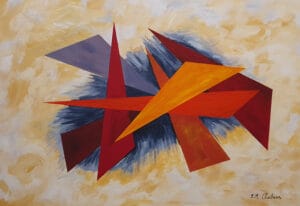
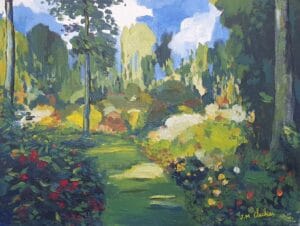
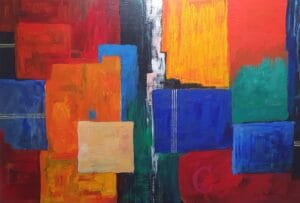
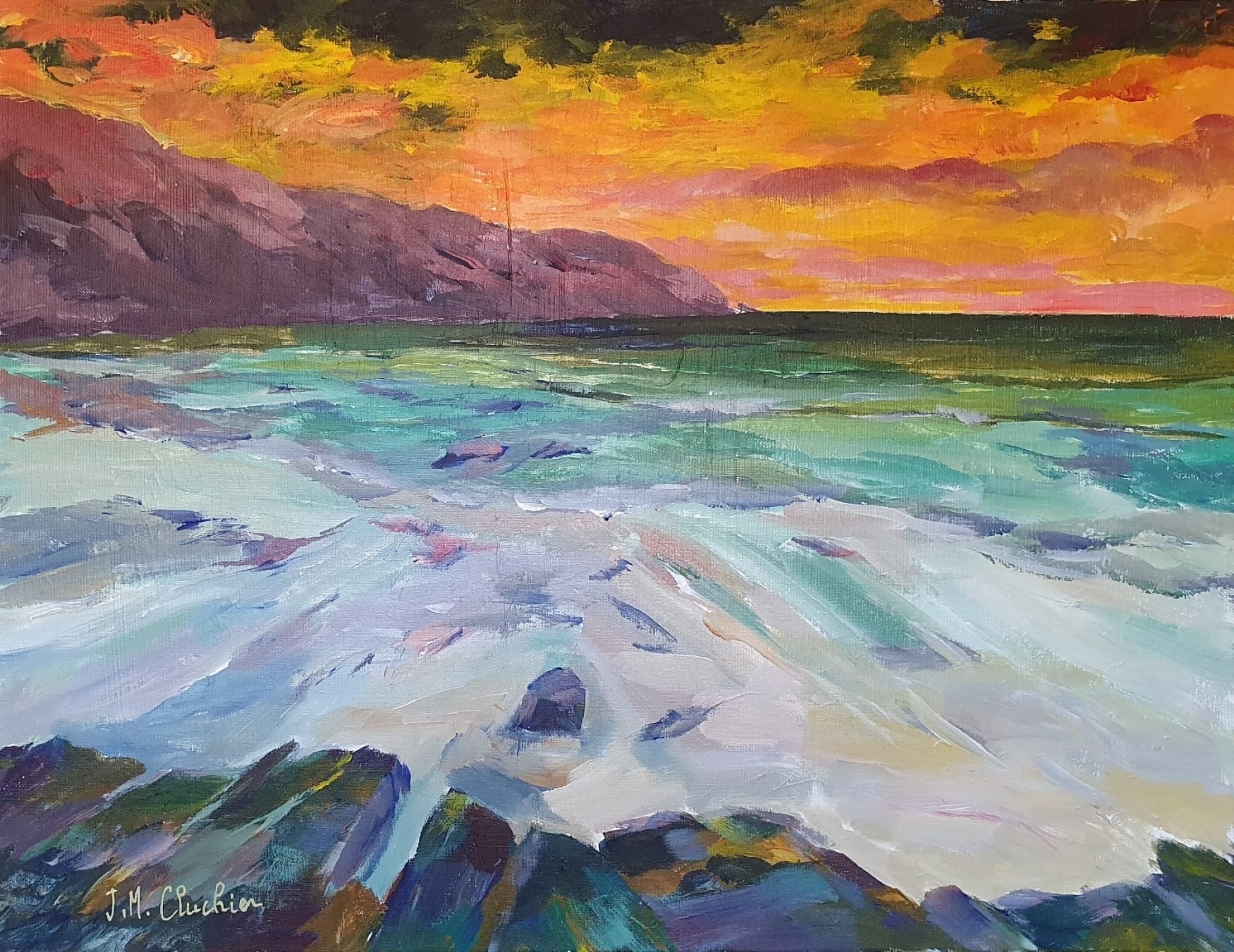
You will find this influence in several of my expressionist paintings available here.
Four Iconic Works
The Scream — Edvard Munch (1893)
National Gallery, Oslo, Norway
A crucial precursor, this seminal painting depicts a human figure with an open mouth overlooking a fjord swirling with orange waves. More than just a painting, it is an icon of modern anguish—and the starting point for all that followed in Expressionist art.
The Last Supper — Emil Nolde (1909)
Nolde Foundation, Seebüll, Germany
Nolde paints the final scene of Christ with astonishing chromatic violence: the apostles with masked faces, the clashing reds and yellows. A spiritual and savage reinterpretation of an age-old subject.
Self-Portrait with Bandaged Hand — Egon Schiele (1909)
Leopold Museum, Vienna
The artist’s gaunt, frontal body is presented as a visible wound. Schiele deconstructs the myth of the glorious self-portrait, transforming it into a clinical document on human vulnerability.
Dresden Street — Ernst Ludwig Kirchner (1908)
Museum of Modern Art (MoMA), New York
Five women walk down a nighttime street. Their faces are masks, their silhouettes elongated shadows. The modern city appears as a haunted stage set—elegant and terrifying at the same time.
Museums where you can see the greatest Expressionist masterpieces
Brücke Museum, Berlin
Städel Museum, Frankfurt
Leopold Museum, Vienna
Nolde Foundation, Seebüll
Thyssen Museum, Madrid
MoMA, New York
Neue Galerie, New York
Tate Modern, London
Color and Perspective: Two Weapons Against Reality
What fundamentally distinguishes the Expressionist from the Realist is their relationship to color. Where the latter seeks to represent observable light, the former uses color like musical notation: each tone has its own emotional value, independent of its optical “truth.”
Expressionists often developed personal chromatic systems, almost secret languages. Jawlensky associated red with spirituality, black with silence, and white with divine light. Nolde constructed his canvases on extreme complementary contrasts—oranges against blues, yellows against violets—which make the pictorial surface vibrate like an electric field.
As for perspective, Expressionists understand it not as a geometric rule but as a malleable expressive tool. In classical painting, perspective simulates the depth of real space. In Expressionism, it simulates the depth of inner space. The figures, close together, overwhelm the space; the architecture leans according to the psychological pressure of the scene; faces are enlarged or distorted according to their emotional weight within the composition.
It is precisely this freedom—chromatic freedom, spatial freedom—that has nourished my own practice. In my artistic approach, I apply these principles to contemporary subjects: the light of the Atlantic, faces marked by time, coastal landscapes imbued with shifting atmospheres.
The Legacy: How Expressionism Influences Contemporary Art
Expressionism did not die with the exile of its founders. It crossed the Atlantic, merged with other movements, and continues to influence world painting to this day.
American Abstract Expressionism of the 1940s and 50s—with Willem de Kooning, Franz Kline, and Mark Rothko—represents the first major wave of its legacy. Pollock’s violent gestural style, Rothko’s field painting where color occupies the entire canvas like a physical presence: all this would be unthinkable without the lessons of Die Brücke and Blaue Reiter.
In Europe, the CoBrA movement (Karel Appel, Asger Jorn, Pierre Alechinsky) revived the expressive brutality and chromatic freedom of the Expressionists in the postwar period. Later, the Neo-Expressionism of the 1980s—with Anselm Kiefer, Georg Baselitz, and A. R. Penck in Germany, and Jean-Michel Basquiat in the United States—reaffirmed with a resounding force the power of gesture and figure.
Living artists who claim this heritage
Among contemporary painters who openly cite Expressionism as a source: Anselm Kiefer, whose monumental canvases blend raw materials and German historical references; Georg Baselitz, who paints his figures upside down to free painting from its narrative function; Marlene Dumas, a South African painter whose distorted portraits carry a political and emotional charge directly inherited from Schiele; or Peter Doig, whose psychic landscapes evoke the unsettling atmosphere of Munch’s works.
The Value of Expressionist Masters
German Expressionism is currently one of the most sought-after segments of the global art market. Major auction houses—Christie’s, Sotheby’s, Drouot—regularly achieve record prices for these works.
Egon Schiele ~€40M Rückenakt — Sotheby’s, 2021
Ernst Ludwig Kirchner ~€38M Berliner Straßenszene — Christie’s
Emil Nolde ~€9M Seascapes — Hauswedell & Nolte
Alexej von Jawlensky ~€6M Abstract Heads Series — various
Max Beckmann ~€22M Allegorical Triptychs — Christie’s
Demand for these works remains strong, particularly from American, Asian, and Middle Eastern collectors. Prices have increased five to tenfold since the 1990s. Even works on paper—watercolors, prints, drawings—reach considerable sums, proving that it is the intensity of the gesture, more than the format, that determines the value.
For the discerning collector, the appeal of contemporary Expressionist-inspired art lies precisely in this living legacy: a work that engages with Nolde or Schiele carries within it centuries of emotional and formal tension.
In conclusion
German Expressionism is not a lesson in art history. It is a way of being before the canvas—an existential stance. To paint Expressionistically is to accept that color can deceive reality in order to better express the truth. It is to understand that distortion is not a mistake but an intention. It is to embrace that painting can be a cry as much as an image.
My own painting style has developed through this dialogue: first with Nolde, then with Jawlensky and Schiele, and with all those artists who refused to paint what they saw in order to paint what they felt. It is this legacy that I try to honor in my work—and that I invite you to discover.