20th Century Painting and Its Evolution Towards Contemporary Art
The 20th century was, without question, the most revolutionary century in the entire history of painting. Over the course of a hundred years, artists shattered the academic codes inherited from the Renaissance, invented radically new visual languages, and fundamentally transformed our relationship to the painted image. From the Douanier Rousseau to Warhol’s pop art, through the great utopias of abstraction, each decade brought its own rupture, its own vision of the world. Understanding these movements means understanding how contemporary painting was born — and why it continues, even today, to speak to us with such force.
The Major Painting Movements of the 20th Century
1. Naïve Art
Definition and history. Naïve art refers to works by self-taught artists with no formal academic training, who paint with a sincerity and visual freshness far removed from classical conventions. Compositions are often flat, perspective is disregarded, colours are vivid, and subjects are drawn from everyday life or a poetic imagination. Far from being a shortcoming, this divergence from academicism is precisely what gives this style its power.
The leading figure: Henri Rousseau, known as the Douanier Rousseau (1844–1910). A customs officer in Paris, he took up painting late in life and was initially ridiculed before being recognised by Picasso himself as a singular genius. His lush jungles populated by wild animals, his starry nights and dreamlike scenes form an immediately recognisable world. His masterpiece The Dream (1910) is on display at the Museum of Modern Art (MoMA) in New York.
Other major artists. Séraphine Louis (1864–1942), a French domestic servant, painted trees of life bearing hallucinatory fruit, now held at the Musée d’Art et d’Archéologie in Senlis, France. Grandma Moses (Anna Mary Robertson Moses, 1860–1961) depicted rural New England scenes with warmth and charm; her works are in the collections of the Smithsonian American Art Museum in Washington.
An iconic work. The Snake Charmer (1907) by Rousseau, held at the Musée d’Orsay in Paris, perfectly encapsulates this nocturnal, spellbinding world that so fascinated the Surrealists.
2. Fauvism
Definition. Born between 1904 and 1908, Fauvism takes its name from a remark made by art critic Louis Vauxcelles who, on seeing the paintings exhibited at the 1905 Salon d’Automne, exclaimed: “Donatello among the wild beasts!” The movement is characterised by the use of pure, unnaturalised colour applied directly to the canvas in violent flat areas. Colour ceases to be the servant of reality and becomes the vehicle of emotion.
The three major figures. Henri Matisse (1869–1954) is the undisputed leader of the movement. His colourful interiors, odalisques and paper cut-outs profoundly influenced all of the century’s painting. The Dance (1910) is visible at the Hermitage Museum in Saint Petersburg and at the MoMA in New York. André Derain (1880–1954) painted harbours and landscapes in explosive colours, notably his views of London. Maurice de Vlaminck (1876–1958) pushed colour even further, almost into an expressive violence that prefigures Expressionism.
Where to see their works. The Musée d’Art Moderne de la Ville de Paris, the Centre Pompidou, the Musée d’Orsay and the MoMA (New York) all hold significant Fauvist collections.
3. Cubism
Definition and history. Cubism, born around 1907–1908 in Paris, brought about a Copernican revolution in the history of painting: it definitively abandoned the single-point perspective inherited from the Renaissance in order to show an object from several angles simultaneously. The pictorial plane fragments into geometric facets. Two phases can be distinguished: Analytic Cubism (1908–1912), with sober tones, which decomposes form to the point of near-total abstraction, and Synthetic Cubism (from 1912 onwards), more colourful, which reintroduces fragments of reality (collaged papers, lettering).
The founding work. Les Demoiselles d’Avignon (1907) by Pablo Picasso is considered the manifesto painting that opens the way to Cubism. This monumental canvas, on display at the MoMA in New York, shows five female figures with angular contours and faces treated like African masks, breaking with every ideal of classical beauty.
The major artists. Pablo Picasso (1881–1973) and Georges Braque (1882–1963) invented Analytic Cubism together through an intense and fraternal collaboration. Juan Gris (1887–1927) brought Synthetic Cubism to its most refined expression.
Essential museums. The Musée Picasso in Paris, the Musée National d’Art Moderne (Centre Pompidou), the MoMA in New York and the Museo Reina Sofía in Madrid.
4. Dadaism
Definition and revolution. Born in Zurich in 1916, in the midst of the First World War, Dadaism is less a pictorial style than a posture of total revolt against the bourgeoisie, war, reason and institutional art itself. “Dada” means nothing — that is the point. The movement asserts that if rational civilisation produced the barbarity of the trenches, then art must be irrational, absurd, provocative. This radical avant-garde stance is decisive: it frees the artistic gesture from all formal constraints and opens the way to abstraction, Surrealism, and subsequently to the conceptual art of the 20th century.
Two founding examples. Marcel Duchamp (1887–1968) invents the ready-made: a urinal signed “R. Mutt” and titled Fountain (1917) becomes a work of art. This subversive gesture — asserting that it is the artist’s gaze, not handcraft, that makes art — is the starting point for all conceptual art. Hannah Höch (1889–1978) developed political photomontage, cutting and reassembling press images and advertisements to denounce mass society.
5. Mexican Painting
An epic muralism. In the 1920s and 1940s, post-revolutionary Mexico gave birth to one of the most ambitious artistic experiments of the century: muralism. Supported by the state, this movement aimed to educate a largely illiterate people by covering the walls of public buildings with colossal frescos of historical, political and social content.
The key figures. Diego Rivera (1886–1957) is the undisputed master of muralism; his frescos adorn the National Palace in Mexico City and the Detroit Institute of Arts. José Clemente Orozco (1883–1949) brought a darker, more tragic dimension to the movement. David Alfaro Siqueiros (1896–1974) is the most overtly political of the three. One must not forget Frida Kahlo (1907–1954), whose surrealist and autobiographical self-portraits have received worldwide posthumous recognition. Her works are displayed at the Museo Frida Kahlo (“La Casa Azul”) in Mexico City.
6. The Birth of Abstraction
A revolution without objects. Abstraction was born around 1910–1920, from the conviction that painting could express spiritual, emotional or musical realities without recourse to any representation of the visible world. It is one of the most profound ruptures in the entire history of art.
Wassily Kandinsky (1866–1944) is generally recognised as the father of abstraction. His canvas First Abstract Watercolour (c.1910–1913), held at the Centre Pompidou in Paris, marks the moment when colour and form definitively freed themselves from any real referent. His treatise Concerning the Spiritual in Art (1911) lays the theoretical foundations of the movement. Kazimir Malevich (1879–1935) pushed abstraction to its extreme with Suprematism: his Black Square on White (1915), visible at the Russian Museum in Saint Petersburg, reduces painting to its purest forms — square, circle, cross. Piet Mondrian (1872–1944) arrived, via the De Stijl movement, at a plastic vocabulary reduced to black perpendicular lines and three primary colours of absolute rigour (see De Stijl section).
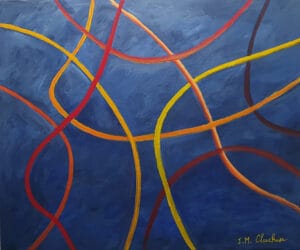
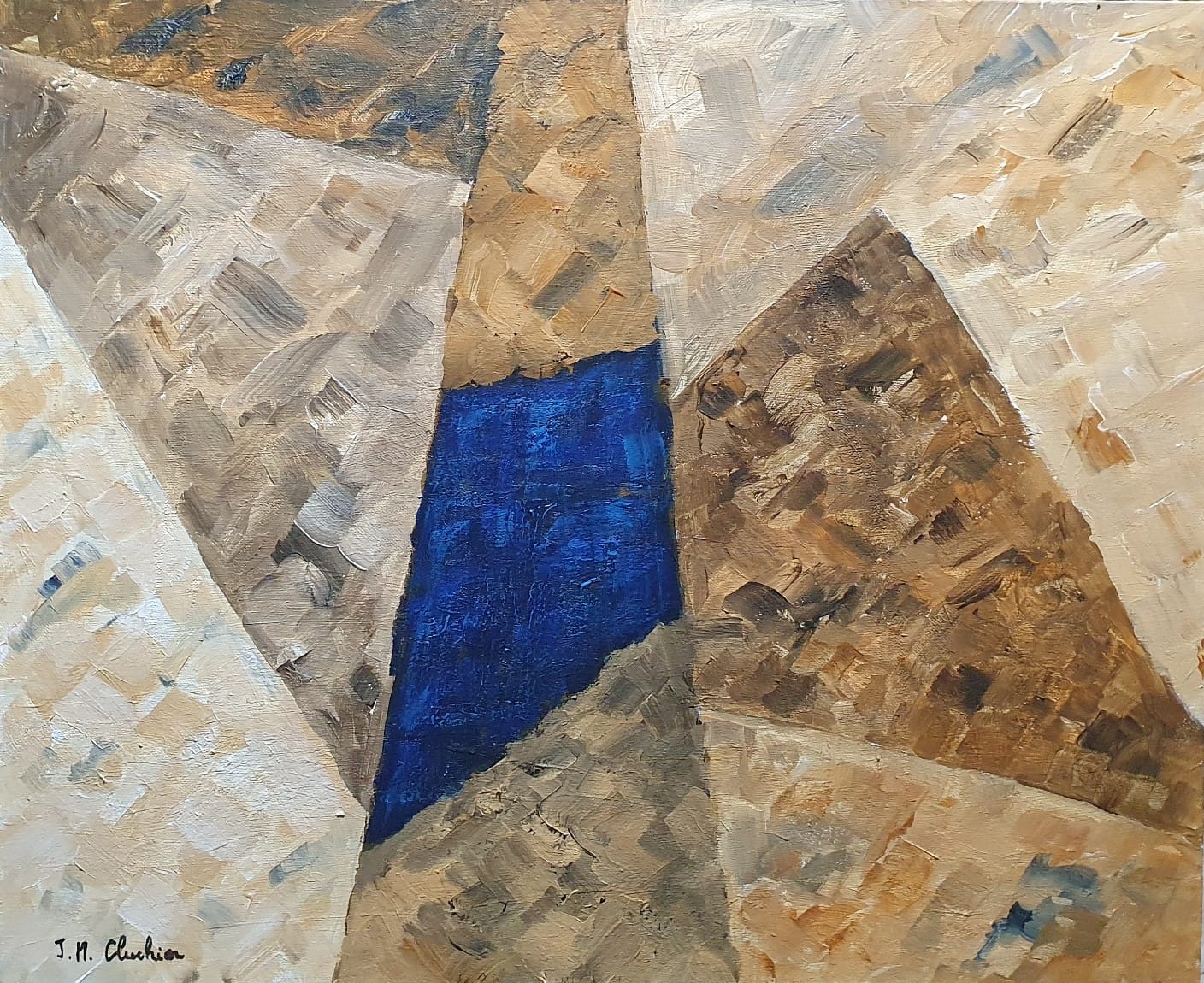
Serge Poliakoff (1900–1969), a Russian-French painter, holds a special place in the pantheon of abstraction. His compositions in broad areas of muted, vibrant colour — ochres, reds, deep greens — are immediately recognisable. Poliakoff refuses cold geometry: his shapes seem organic, almost alive, traversed by an inner light. His painting is an invitation to meditation as much as to chromatic sensuality. Those who appreciate my own painting will recognise in my work this same quest for a warm, sensitive abstraction, profoundly influenced by Poliakoff’s legacy —
discover my abstract paintings on this page.
Three major works to see. Kandinsky’s Composition VIII (Guggenheim Museum, New York); Mondrian’s Broadway Boogie-Woogie (MoMA, New York); Poliakoff’s Abstract Composition (Musée National d’Art Moderne, Centre Pompidou, Paris).
7. The Russian and Soviet Avant-Garde
Definition. Between roughly 1910 and 1930, Russia — and then the USSR — was the birthplace of an unprecedented artistic ferment. Suprematism, Constructivism, Rayonism: these movements asserted that art must participate in building a new world. Constructivism, championed by Alexander Rodchenko (1891–1956) and El Lissitzky (1890–1941), turned towards industrial design, political posters and architecture. Natalia Goncharova (1881–1962) blended primitivism and futurism in explosively vital compositions. These works can be seen at the Tretyakov Gallery in Moscow and the Centre Pompidou in Paris.
8. De Stijl (The Style)
Definition. Founded in the Netherlands in 1917 by Theo van Doesburg, De Stijl (“The Style”) advocated absolute formal reduction: horizontal and vertical lines, primary colours (red, blue, yellow) plus black and white. The utopia was total — to create a universal plastic language, valid for painting, architecture and design alike.
Piet Mondrian (1872–1944), the figurehead of the movement, elaborated his vocabulary of black grids and coloured rectangles now recognised worldwide. His Compositions are on view at the Gemeentemuseum in The Hague (Netherlands), the MoMA in New York and the Centre Pompidou. Theo van Doesburg (1883–1931) and the architect Gerrit Rietveld complete this founding trio.
9. German Expressionism
Definition. German Expressionism was born at the beginning of the 20th century out of the desire to paint not what one sees, but what one feels. Violent colours, distorted contours, anguished subjects: the canvas becomes a mirror of the artist’s psyche and of a society in crisis. Two major groups structured it: Die Brücke (The Bridge, founded in Dresden in 1905) and Der Blaue Reiter (The Blue Rider, founded in Munich in 1911).
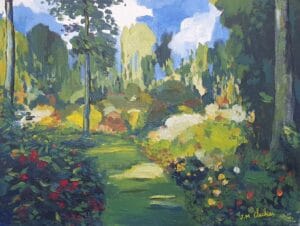
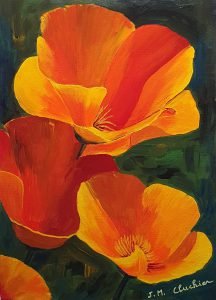
Emil Nolde (1867–1956) is one of the most powerful figures of this current. His landscapes of the Schleswig-Holstein marshes, his flowers in incandescent colours and his religious scenes emit a rare emotional intensity, carried by thick pictorial matter and a palette of reds, yellows and greens of breathtaking brutality. Nolde is one of the artists who has most deeply marked my own approach to painting: this way of using colour as raw emotion, without mediation, runs through my daily work. Discover how this Expressionist legacy manifests itself in my paintings. His major works are held at the Nolde Stiftung Seebüll (Niebüll, Germany) and at the Museum of Modern Art in New York.
Ernst Ludwig Kirchner (1880–1938), founder of Die Brücke, painted Berlin’s streets with a nervous rawness that can be seen at the Brücke-Museum in Berlin. Franz Marc (1880–1916) and Wassily Kandinsky animated Der Blaue Reiter, crossing spirituality with pure colour.
10. New Objectivity (Neue Sachlichkeit)
Definition and historical context. New Objectivity was born in Germany around 1920, as a reaction against Expressionism, which was considered too subjective. In the Weimar Republic ravaged by war, inflation and social misery, painters chose to depict social reality with icy precision and corrosive irony. They portrayed the scarred, the war-wounded, prostitution and the decadence of a bourgeoisie blind to its own demise.
The three masters. Max Beckmann (1884–1950) composed large allegorical triptychs in which twisted figures symbolise the human condition trapped by History — see The Acrobats or the triptych Departure (1932–1933) at the MoMA in New York. Otto Dix (1891–1969) depicted war in its most brutal truth: his triptych The War (1929–1932), on display at the Gemäldegalerie Neue Meister in Dresden, is one of the most devastating anti-war works of the century. George Grosz (1893–1959) used satirical drawing to attack the German military and bourgeois class with unprecedented ferocity.
The rise of Nazism brutally ended this movement: most of these works would be classified as “degenerate art” (Entartete Kunst) and their authors forced into exile or silence.
11. Surrealism
Definition and motivations. Founded in Paris in 1924 by André Breton with the publication of the Surrealist Manifesto, Surrealism sought to liberate the forces of the unconscious — dreams, repressed desires, fantasies — and bring them into art. Inspired by Freudian psychoanalysis, it asserts that the deep reality is not that of the visible world but that of the dream world.
The movement’s leading artists. Salvador Dalí (1904–1989) is the public face of Surrealism with his melting watches and hypnotic dreamscapes — The Persistence of Memory (1931) is at the MoMA in New York. The Teatre-Museu Dalí in Figueres (Catalonia) is his personal monument. René Magritte (1898–1967) established a Surrealism of thought: his unsettling images question language and representation — the Magritte Museum in Brussels is dedicated to him. Max Ernst (1891–1976), Joan Miró (1893–1983) and Yves Tanguy (1900–1955) complete this pantheon, whose works are widely visible at the Centre Pompidou and the MoMA.
12. The New York School — Abstract Expressionism
Definition. After the Second World War, the centre of gravity of world painting shifted from Paris to New York. Abstract Expressionism, or the New York School, brought together in the 1940s and 1950s painters for whom the act of painting — the gesture itself — became the primary subject of the work.
Jackson Pollock (1912–1956) invented dripping: he poured, splashed and trickled paint onto a canvas laid on the floor, creating networks of interwoven lines of telluric power. His large canvases are on view at the MoMA in New York. Mark Rothko (1903–1970) developed floating rectangular colour fields of hypnotic meditative intensity. The Rothko Chapel in Houston, Texas, is a unique place of contemplation. Willem de Kooning (1904–1997) combined figuration and abstraction in surfaces painted with furious gestural energy.
13. Mannerism in the 20th Century
Definition. In a broad sense, Mannerism refers to an art that deliberately feeds on the art that preceded it — a painting “about painting”. In the 20th century, this stance is found in artists who revisit, distort or reinvent the old masters with subtle irony or heightened dramatism. Francis Bacon (1909–1992) is exemplary in this regard: his human figures, twisted inside transparent cages, cry out a profoundly modern existential anguish. His major works are at Tate Modern in London and at the Dublin City Gallery The Hugh Lane.
14. Pop Art
Definition. Born in Britain in the late 1950s, but most strongly associated with the United States of the 1960s, pop art (short for popular art) brought the images of mass culture into museums: advertisements, comic strips, celebrities, consumer goods. It was both a celebration of and a questioning of American consumer society.
Three unmissable names. Andy Warhol (1928–1987) serialised icons — Campbell’s soup cans, Marilyn Monroe portraits, electric chairs — in an aesthetic of mechanical repetition. The Andy Warhol Museum in Pittsburgh and the MoMA in New York hold his major works. Roy Lichtenstein (1923–1997) enlarged comic-strip panels to monumental scale, with their halftone dots made visible. David Hockney (born 1937) developed a more poetic and luminous version of British pop art: his Californian swimming pools, English gardens and portraits are immediately recognisable. His paintings can be seen at Tate Modern in London and at the Los Angeles County Museum of Art (LACMA).
15. Minimalism
Definition. Minimalism, which asserted itself in the United States in the 1960s, reduces painting to its most fundamental elements: form, colour, surface. All narration, all symbolism, all reference to anything outside the work is eliminated. The famous phrase of Frank Stella (1936–2024) perfectly encapsulates the idea: “What you see is what you see.” No more, no less. His striped monochrome canvases, followed by his sculptural aluminium reliefs, are visible at the MoMA in New York and at Tate Modern.
Other artists of the movement. Ellsworth Kelly (1923–2015) composed coloured shapes of absolute purity. Agnes Martin (1912–2004) developed delicate linear grids of serene meditation. Robert Ryman (1930–2019) explored infinite variations of white on white.
Painting in the 21st Century: Legacies and New Voices
A Painting That Inherits Everything and Belongs to Nothing
Today’s painting differs fundamentally from that of the previous century in one essential way: the absence of a dominant movement. Gone are the manifestos, the chapels, the isms that imposed themselves as collective revolutions. In the 21st century, plurality reigns: figuration and abstraction coexist, dialogue and cross-pollinate. A contemporary painter can draw simultaneously on Nolde, Rothko and traditional Chinese painting without any sense of contradiction. Cultural globalisation, instant access to the entire history of art’s images via the internet, and the rise of new art markets (China, India, Africa, Brazil) have freed painting from all geographical or stylistic obligation.
Yet the great formal conquests of the 20th century have left deep marks on the way painting is made today. The freedom of colour inherited from Fauvism, the deconstruction of form from Cubism, the primacy of raw emotion from Expressionism, the chromatic meditation of abstraction, and the subversion of codes characteristic of Dadaism and pop art: all these legacies are present, in hybrid and renewed forms, in contemporary painting.
The Major Tendencies of Contemporary Painting
The return of figuration. After decades of abstraction and conceptual art dominance, the 2000s and 2010s saw a massive return of figurative painting. But this is not a step backwards: this new figuration is shot through with all the formal conquests of the previous century. Bodies are deformed, fragmented; spaces are psychological rather than narrative; and colour remains an autonomous actor in the composition.
Abstraction continues. Far from being exhausted, abstract painting has renewed itself by integrating new materials, new scales and new extra-Western cultural references. It now explores territories where the surface of the canvas becomes almost architectural.
The hybridisation of media. The boundary between painting, photography, video and installation has blurred considerably. Many contemporary painters integrate photographic or digital processes into their practice without abandoning gestural, material painting.
Social and political commitment. Faced with climate crises, inequalities and questions of identity, many contemporary artists have reintroduced a narrative and engaged dimension into painting that recalls the Mexican murals of the early century, but with the formal tools of contemporary art.
Five Essential Contemporary Painters
Gerhard Richter (born 1932, Germany)
The tutelary figure of contemporary painting worldwide, Richter is both the most radical and the most unclassifiable painter of his era. He oscillated throughout his life between photo-painting (reproducing blurred photographs in oil paint) and pure abstraction (his Abstrakten Bilder, elaborated by scraping successive layers of paint). Trained in Dresden in East Germany, he discovered in 1961, during a visit to Düsseldorf just before the Berlin Wall was built, the Western art that had been denied to him. This dual belonging — Socialist Realism and Western avant-garde — nourishes his entire oeuvre. His influence on the next generation is immense, particularly in the way he interrogates the photographic image and collective memory. His works are on view at the Museum Ludwig in Cologne, the MoMA in New York, Tate Modern in London and the Centre Pompidou in Paris.
Marlene Dumas (born 1953, South Africa)
Marlene Dumas has established herself as one of the most powerful voices in contemporary figurative painting. Her portraits, nudes and figures — executed in ink, watercolour and oil paint in intimate formats — tackle head-on the questions of desire, death, race and identity. Born in South Africa under apartheid and living in Amsterdam since the 1970s, she makes human vulnerability her territory. The Expressionist legacy — Nolde, Schiele, Bacon — is manifest in her way of distorting the face to reveal its interiority. Her works are exhibited at the Stedelijk Museum in Amsterdam, the MoMA in New York and Tate Modern.
Cecily Brown (born 1969, United Kingdom)
Based in New York, Cecily Brown achieves a synthesis between the Abstract Expressionism of the New York School — whose legacy she explicitly claims — and a baroque, sensual figuration. Her large canvases, laden with matter and colour, seem on the verge of tipping between the figurative and the abstract: bodies, gestures and landscape fragments can be discerned, but everything is swept up in a chromatic whirlwind. She engages equally with the Old Masters (Rubens, Delacroix) and with De Kooning. Her paintings are in the collections of the Metropolitan Museum of Art and the Guggenheim Museum in New York.
Njideka Akunyili Crosby (born 1983, Nigeria)
Representative of a generation of painters who grew up between two cultures, Njideka Akunyili Crosby (based in Los Angeles) integrates into her large acrylic canvases photographic transfers depicting Nigerian popular culture — magazines, Nollywood posters, family photographs. Her works explore with great psychological subtlety the questions of hybrid identity, cultural displacement and domestic intimacy. The legacy of pop figuration — in the way she handles the photographic image and mass culture — is evident, but revisited through the prism of an African experience. She is exhibited at the Whitney Museum of American Art (New York) and at Tate Modern.
Jonas Wood (born 1977, United States)
Jonas Wood has developed a distinctive form of figurative painting: domestic interiors, potted plants, portraits, basketball courts — apparently mundane subjects treated with a flatness and chromatic intensity inherited in equal measure from pop art and Japanese printmaking. In his canvases, patterns layer and overlap, perspectives flatten, and colours ring out with a gaiety that conceals a latent unease. His work perfectly illustrates how contemporary painting can be simultaneously narrative, abstract in its structure and emotionally charged. His works are in the collections of LACMA (Los Angeles), the MoMA and the Hammer Museum.
The Influence of 20th-Century Movements on Today’s Painting
How do the great formal revolutions of the last century continue to nourish contemporary painting? The answer lies in several fundamental legacies. The freedom of colour — won by Fauvism and Expressionism — is now a given: no contemporary painter feels obliged to respect the natural colour of an object or a face. This conquest, dearly earned by generations of misunderstood or censured artists, is now the common heritage of all.
The deconstruction of composition inherited from Cubism has freed the painter from the tyranny of central perspective and single viewpoint. A painter like Njideka Akunyili Crosby can superimpose several spaces, several temporalities on a single surface without this being perceived as a failure.
Abstraction — in its Kandinskian, Suprematist, Rothkian or Poliakoffian forms — demonstrated that painting had no need of the visible world to be profoundly meaningful. This lesson remains central: even the most figurative painters of today think their compositions in terms of colour fields, formal tensions and balances that abstraction has taught us to name.
Finally, the subversion of codes stemming from Dadaism and pop art allows contemporary painting to incorporate any material, any image, any cultural reference — high or low, learned or popular — without any pre-established hierarchy. It is this total freedom that perhaps best characterises the painting of the 21st century.
Conclusion
20th-century painting has bequeathed us an unprecedented freedom: the freedom to paint what we feel rather than what we see, to break forms rather than respect them, to invent our own language rather than copy someone else’s. This freedom is demanding — it requires from the artist a deep inner coherence, a distinctive voice — but it is also the condition of all artistic sincerity.
My own painting is rooted in this dual lineage: on one side, the German Expressionism of Emil Nolde, with this way of using colour as a raw emotional language, without mediation; on the other, the warm, sensitive abstraction of Serge Poliakoff, whose large colour-field compositions taught me that geometry could be as alive and organic as a forest in autumn. You will find on my website the paintings that bear witness to this heritage, in the hope that they will inspire you, in turn, to immerse yourself in the fascinating world of modern and contemporary painting.