When a novice viewer is confronted with an abstract painting, a common reaction sometimes arises: “It’s random” or “It’s chaos.” Yet, nothing could be further from the truth. While figurative art relies on reality to guide the eye (a face, a landscape, a still life), abstract art can only count on one thing to exist and move us: composition.
Far from being a random splash of paint, a successful abstract work is the result of intense reflection and rigorous structuring. It is a language without words where each element must find its precise place. Let’s delve together into the heart of this secret mechanism.
1. The absolute necessity of composing
Why is composition vital in abstraction? Imagine a sentence whose words are thrown together at random. It would make no sense. In painting, it’s the same.
In figurative art, the subject holds the painting together. Even if the composition is flawed, we recognize a tree or a house, and the viewer’s mind latches onto it. In abstract art, the safety net of the “subject” disappears. If the composition falters, the painting collapses; it becomes purely decorative at best, or visually distracting at worst.
Composition is the foundational act by which the artist transforms the emptiness of the canvas into a coherent universe. It is an absolute necessity for transforming the chaos of raw emotions into an intelligible visual experience. Without this invisible framework, the work cannot communicate.
2. The role of composition: To guide and move
The primary role of composition is to create a visual path. The artist is a director. Through the placement of lines and masses, they decide where the viewer’s eye will enter the canvas, where it will linger, and how it will exit.
A successful composition creates a rhythm. It can be static to evoke calm and meditation, or dynamic to suggest movement and energy. It serves to prioritize visual information:
The focal point: This is the dominant area, the one that immediately captures attention.
The flow: This is how the gaze glides from one element to another without ever getting lost.
In short, composition is the syntax of emotion. It allows one to convey a sudden anger through broken lines and a fragmented composition, or a profound serenity through calm horizontals.
3. Color balance: A matter of weight
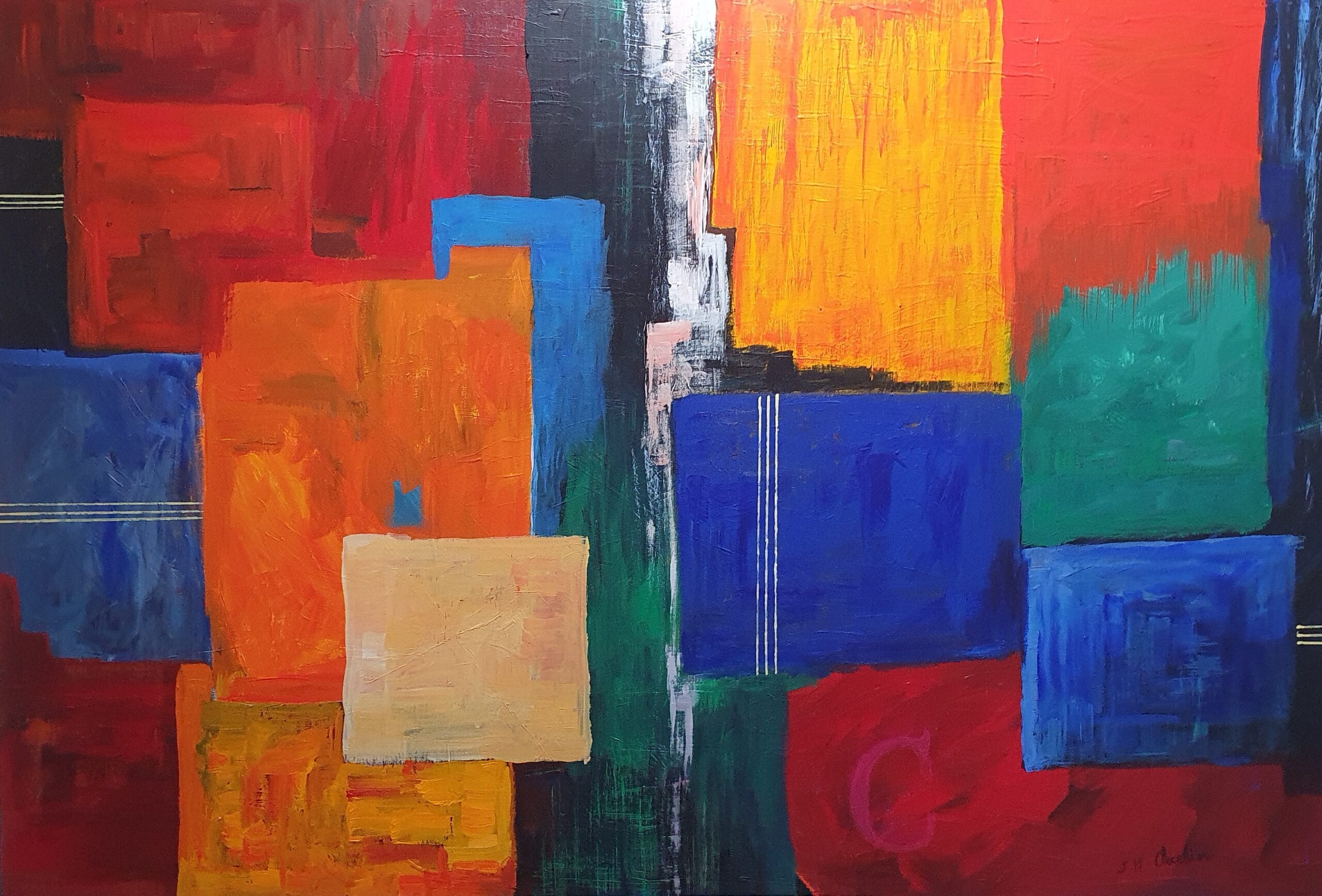
In the creation of an abstract work, color is not merely a hue; it carries weight. The artist must manage the balance of colors like an architect manages the distribution of loads.
This is where the magic happens. A vast area of neutral gray can be perfectly balanced by a tiny touch of vibrant red. Why? Because red has a visual weight, density, and power of attraction far greater than gray.
The artist plays on several levels:
Temperature: The opposition between warm colors (which move toward the viewer) and cool colors (which recede) creates depth without traditional perspective.
Value: The contrast between shadow and light structures the space.
Harmony and dissonance: Sometimes, the goal is not perfect harmony, but a deliberate tension that draws the eye.
A successful abstract composition is often one where, if a single patch of color were removed or altered, the entire structure would collapse.
4. The balance of forms and geometry
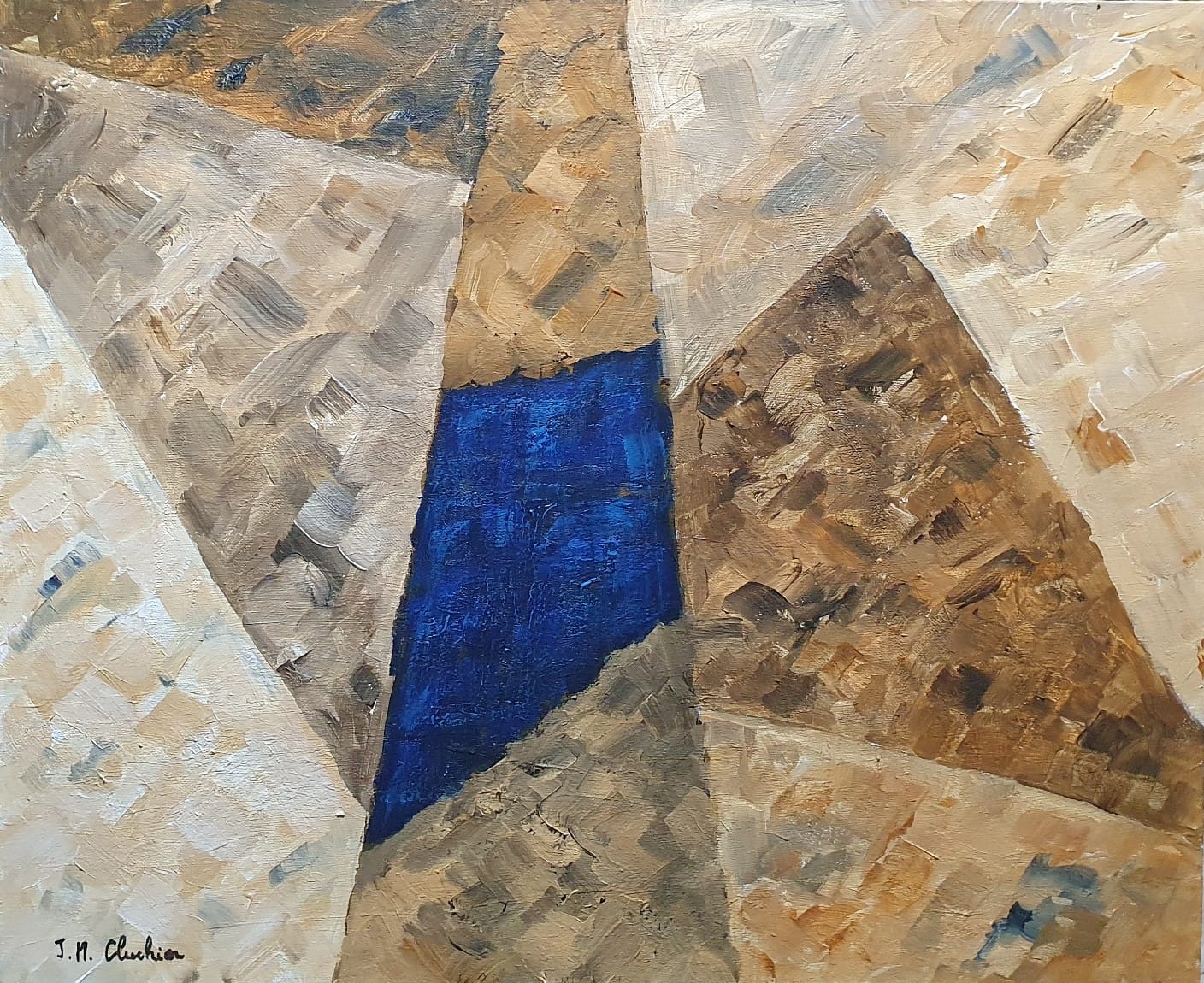
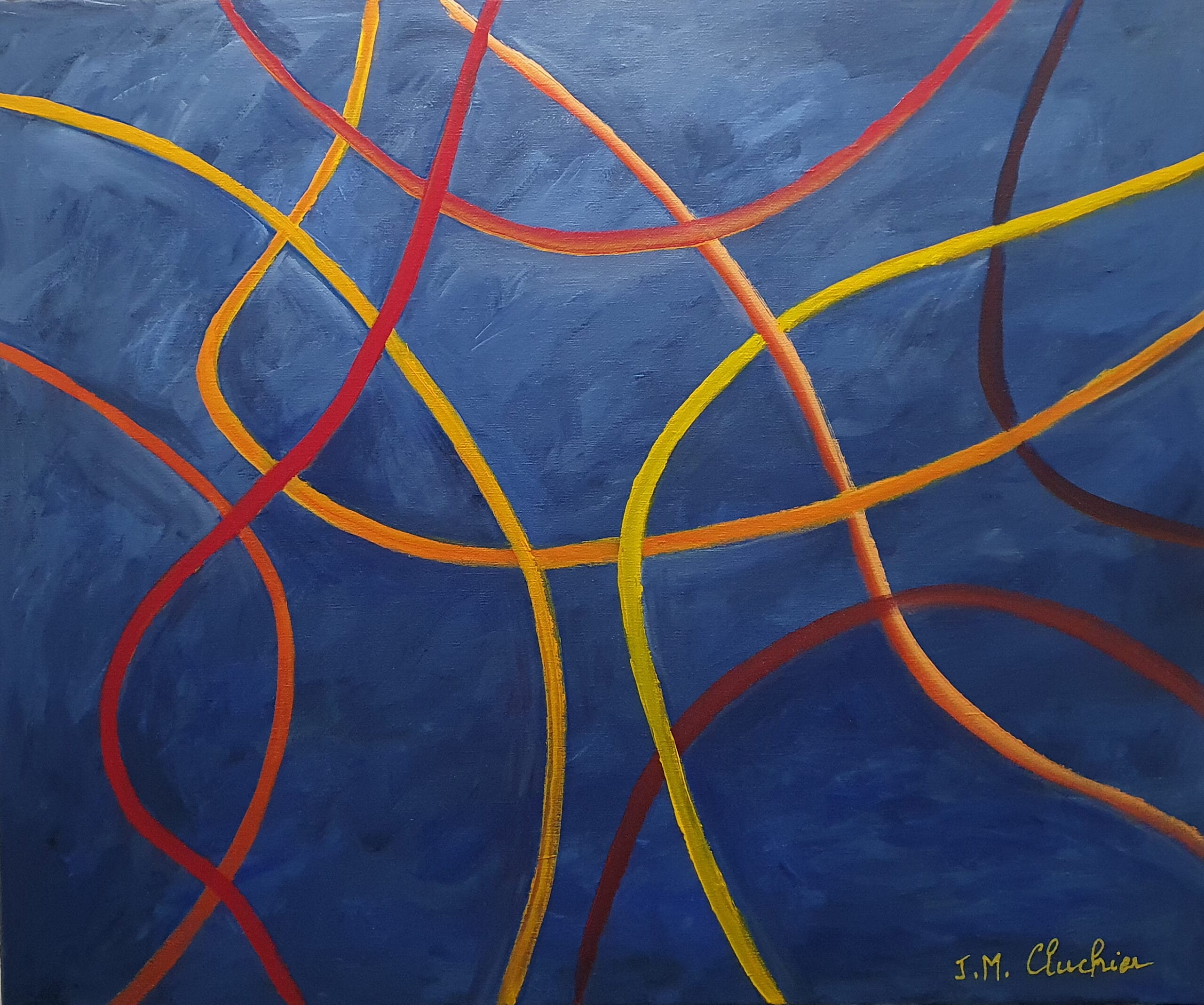
If color is emotion, then form is the body of the artwork. Whether geometric (squares, circles, triangles) or organic (fluid forms, biomorphic patches), their arrangement is crucial.
In geometric abstraction, the rigor of the forms imposes stability. The square anchors, the circle unifies, the triangle energizes. Here, the artist seeks proportional relationships, often influenced by the Golden Ratio or invisible grids.
Conversely, in lyrical abstraction, forms clash or merge. But even here, balance reigns supreme. It is a matter of managing the relationship between “fullness” and “emptiness.”
Negative space (the “empty” areas of the canvas) is as important as the painted forms. It is the silence between the musical notes. A painting that is too full suffocates; a painting that is too empty bores. Composition consists of finding that right balance between the forms that occupy the space and the void that allows them to exist.
5. The evolution of styles: From rigid grids to "All-Over"
The way we compose has radically evolved since the beginnings of abstraction in the early 20th century to the present day.
The pioneers (Kandinsky, Mondrian, Malevich): Initially, composition often sought a spiritual or mathematical harmony. With Mondrian, composition is a strict grid, a search for the absolute and for universal balance. Kandinsky, on the other hand, composed like one writes a symphony, with movements and climaxes.
The turning point of Action Painting (Pollock, De Kooning): In the mid-20th century, the American Abstract Expressionists broke the rules. Jackson Pollock introduced the “All-Over” technique. Here, there is no single focal point, no top or bottom. The composition extends uniformly across the entire surface, almost overflowing the frame. Energy is everywhere; the eye never rests.
Contemporary abstraction: Today, contemporary artists (like the one you can discover on this site) enjoy total freedom. They draw on history to blend genres. We see compositions that combine the geometric rigor of minimalism with the spontaneity of expressionist gesture. The digital age has also influenced composition, introducing new notions of layering, transparency, and saturation.
Conclusion
Looking at an abstract painting means accepting that you’re not looking for a literal narrative, but rather for a sense of tension, balance, and vibration. Composition is the tool that makes this encounter possible. It transforms inert matter into a living presence.
The next time you browse the virtual gallery or pause before a canvas, try to discern this invisible structure. Ask yourself how your eye travels, why one color resonates with another, and how the artist has tamed the void to create a harmonious whole. This is where the true secret of abstract art lies.